Group Exhibition: Tracing the Rupture

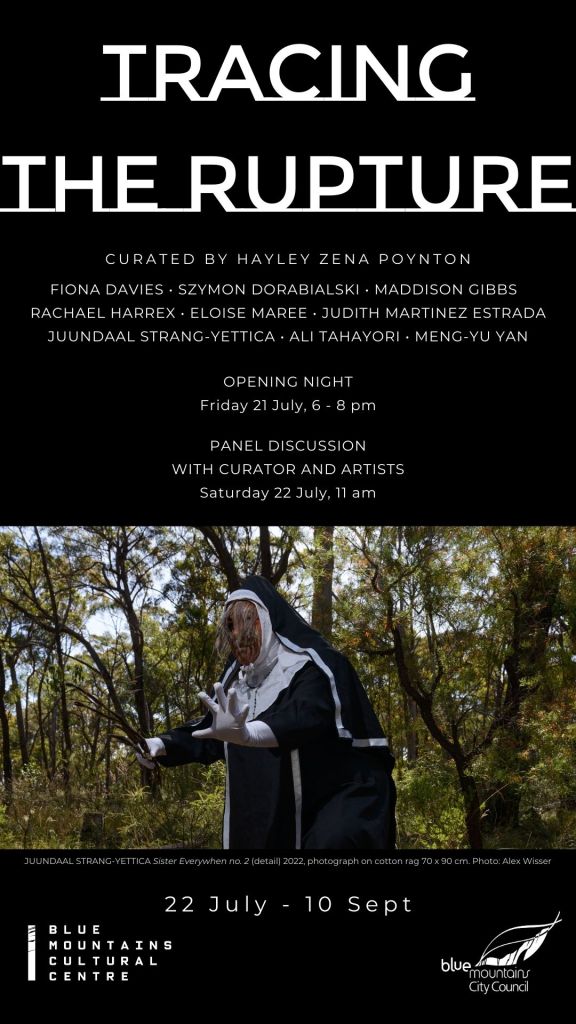
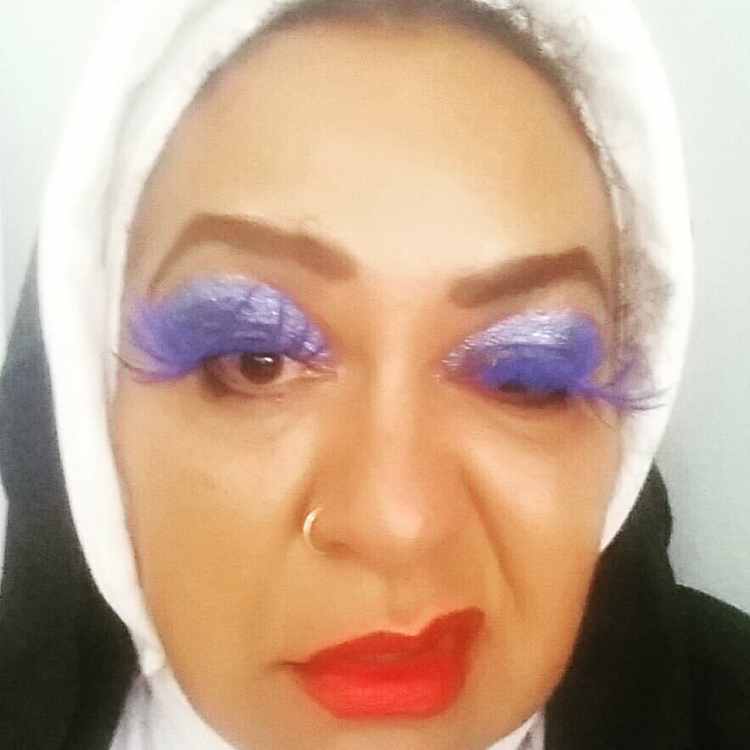
Thrilled to have been invited to show my work, Sister Everywhen, in this group exhibition, Tracing the Rupture, curated by Hayley Zena, at the Blue Mountains Cultural Centre, with this incredible line up of artists!

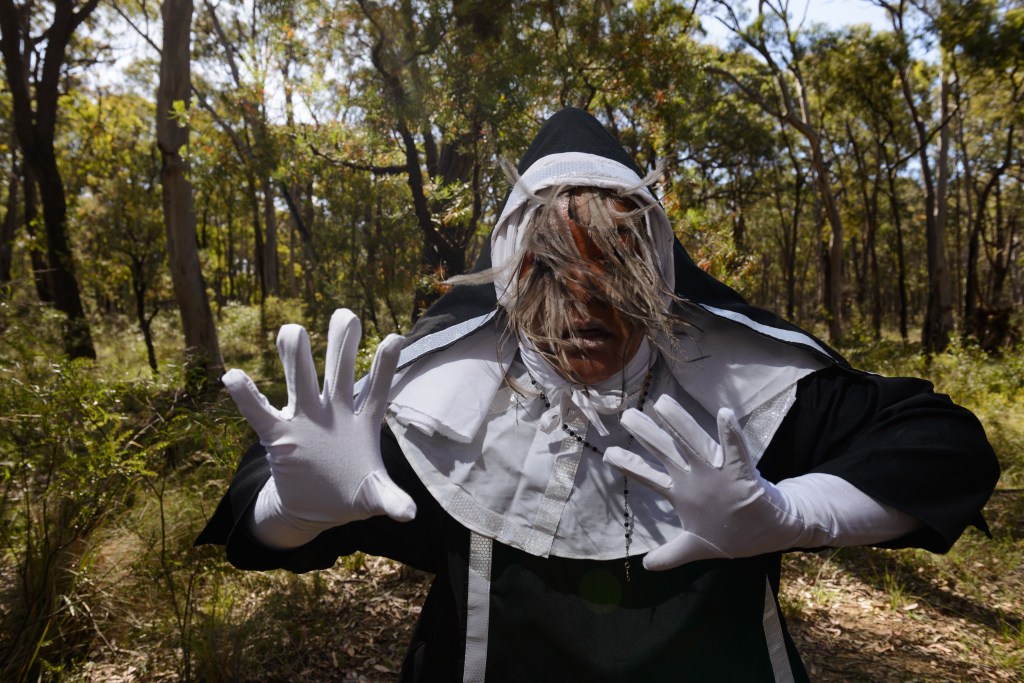
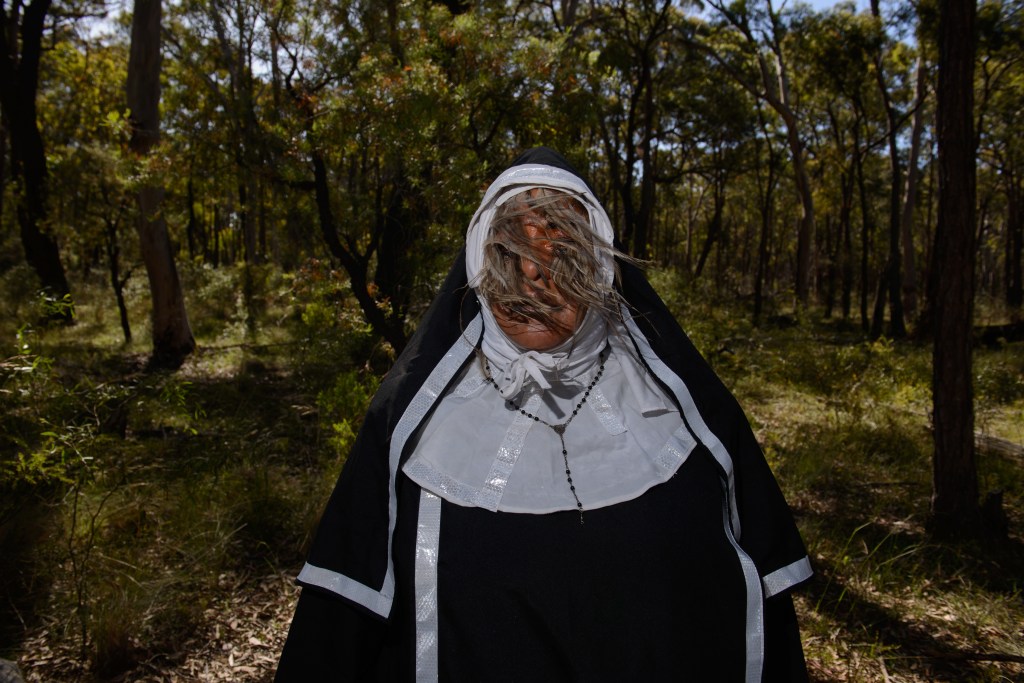
Sister Everywhen, 2022, Photography: Alex Wisser, taken on Dabee-Wiradjuri Land, New South Wales.

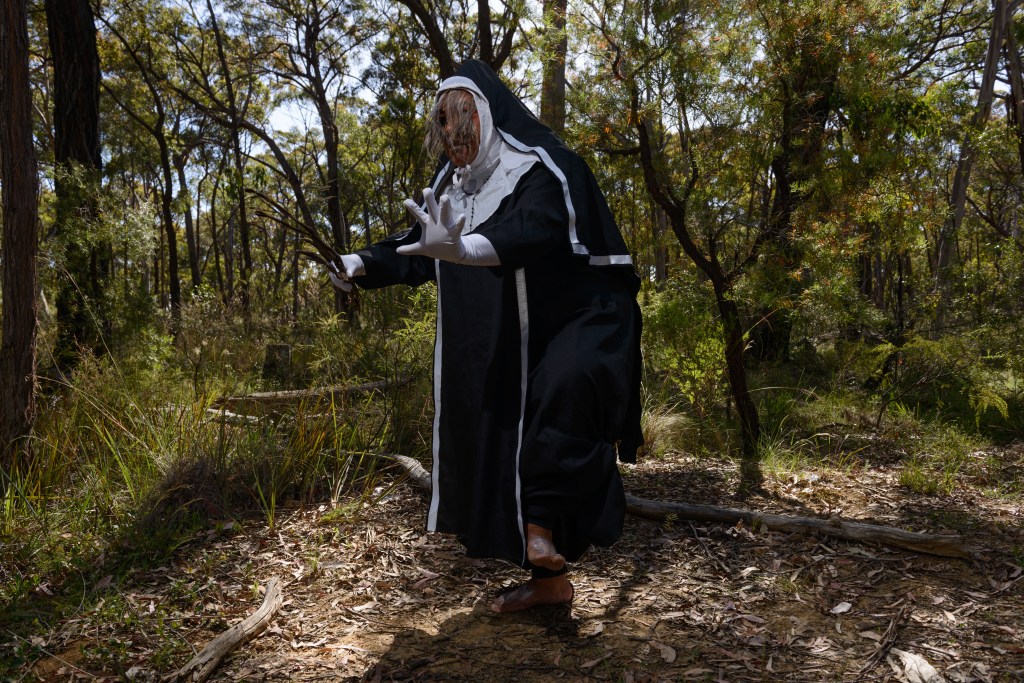
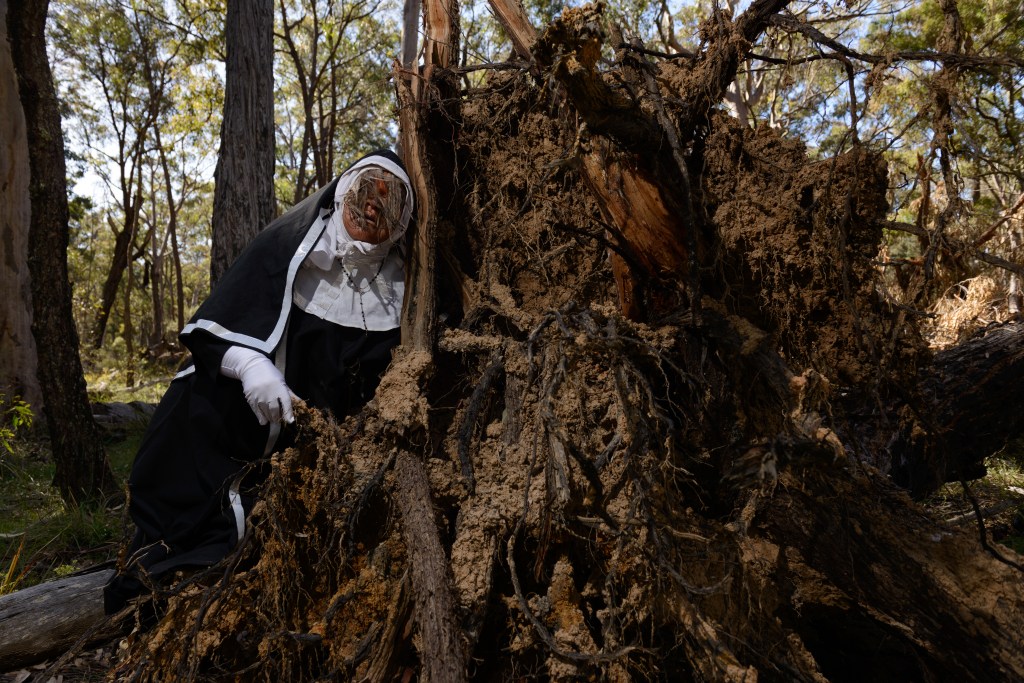
Sister Everywhen is a realisation, a deep, knowing of her circumstance. She is a moment of recognition within Sister GlitterNullius’ own consciousness. Sister Everywhen exists as thought, memory, emotion, epistemology and ontology. Within the truth of this recognition, Sister Everywhen is the innocent monster both trapped and finding rest, reprieves with the truth of her ancestral heritage, Nature.

Sister Everywhen, 2022, Photography: Alex Wisser, taken on Dabee-Wiradjuri Land, New South Wales.

Sister Everywhen, 2022, Photography: Alex Wisser, taken on Dabee-Wiradjuri Land, New South Wales.

My many thanx to Hayley for including my work in this fantastic exhibition, all her hard work and presence throughout! Many thanx to the other artists for sharing their incredible worx and my big thankyou’s to my Mentor, Ian Milliss, Photographer & Mentor, Alex Wisser and Fiona Hillary Davies for her encouragement and support.

Juundaal.

Creative Climate Leadership 2023

Image: Creative Climate Leadership, 2023, https://www.creativeclimateleadership.com/latest/creative-climate-leadership-australia-2023-participants-announced/, accessed: 21.09.2023.

Welcome to your Friday afternoon with The Trees! Welcome to our new Tree Guardians!  I hope you’ve all had a groovy, powerful week! Get a cup of something nice…

Thanx for tolerating my radical acceptance preach last week. It was only, just slightly off-course from my blogging about arriving at an intersection for discussing co-care. Co-care is entirely crucial to the project.  However the project functions in the future, however we look after each other and however our interactions with the broader communities, invite social change, reciprocal care will be at the centre. If you remember, we’ve reached a point where a decision about which area of the project we will take the application of a co-care framework to. And there are co-care applications that could be explored for all kinds of policies, decolonisation, repatriation, deaccession, community and public engagement strategies, Aboriginal staff support strategies in all kinds of keeping places… not only art galleries and we haven’t even begun to touch on other possibilities for supporting cross-cultural, cross-disciplinary co-care with the environmental sciences and other stakeholder groups. 

Hey! Surprise! We’re not going down those rabbit holes today! If you’re starting to get the sense that this blogging course is often off-course, then I’m on track! Be thankful you’ve got a cup of something nice and only have this blogging thing once a week! In the meantime, keeping up with the times, today’s blog is to share an outline of the Creative Climate Leadership program I attended last week, 11th-16th September. Designed and delivered by Julie’s Bicycle, https://juliesbicycle.com/, hosted by Bundanon Art Museum, https://www.bundanon.com.au/our-stories/architecture/art-museum-the-bridge/ and supported by Creative Australia, https://creative.gov.au/investment-and-development/leadership-program/creative-climate-leadership-program/, it was a big week.

Given I’ve been in beautiful Illaroo for the week, I thought it important to share some follow-up about the Creative Climate Leadership program, with you. We stayed five nights in Bundanon’s, Bridge accommodation, with nature all around us. Julie’s Bicycle, a not-for-profit organisation, based in London designed and delivers the program and works to empower creatives and mobilise arts sectors to action on climate change, natural and social justice. Started by the music industry in 2007, the program has been delivered to over 250 creatives in 30 countries. The Australian cohort adds another 24 to the evolving network. The full list of Australia’s Creative Climate Leadership participants and Facilitators is here, https://www.creativeclimateleadership.com/latest/creative-climate-leadership-australia-2023-participants-announced/, and what an incredible bunch of creatives! 

The weeks’ program was absolutely packed, 9am until at least 9pm, every day! Sessions included, Connecting to Country, Culture and Climate Change, Collaborating with First Nations People, Leadership and Resilience. One of my favourite sessions was the Welcome to Country ceremony which was led by Uncle Paul McLeod with The Doonooch Dancers. Some from the program offered Acknowledgements in reply, in language and in English, which made the ceremony even more engaging. The other two program sessions that stand out are, our artists’ expo and the workshops led by participants. 

There wasn’t enough time that we could attend every workshop – we were each able to get to about one out of three on any day. It would have been amazing to go to all of them! From the workshops I went to, I got to make kin and performance with compost, failure and time; explore decolonial storytelling and scaled green targets for theatre, to recall a few. The workshops were a great opportunity to engage as a participant within other artist’s ways of seeing and making – mind officially blown! Within the context of the program and creative leadership, there was much to learn and be inspired by from the artists and their workshops! 

There was a lot to take in and I haven’t processed the learning yet. I’m looking forward to hearing evaluations from the other participants. In a nutshell, the program was an opportunity to collaborate and develop ideas around cultural leadership for climate justice and as I unpack the experience, I’ll share with you along the way. One important point to note is that COP, the annual Council of Parties, the United Nations Climate Change Conference, will take place in the United Arab Emirates this year and is planned for Australia, 2026, https://unfccc.int/. Makes me ask… Do we mobilise our project? If so, how? Would it be too far off-course to start conversations about this stuff?…

From the nutshell to the nut…well, she has been the seed of my practice since Plastic-free Biennale, by Lucas Ihlein and Kim Williams in 2020, https://plasticfreebiennale.sydney/about-the-project/! As I mentioned, each artist presented an engagement for our peers at the Creative Climate Leadership program and Sister GlitterNullius, did not let me down! She conducted a frij magnet making workshop, It’s all about you with Sister GlitterNullius, after dinner Tuesday night. As you can probably imagine, folk don’t really want to get up, go out into the cold night to sit in a cold room and be yelled at by a morphing nun-bird! So, the nun helped get things started by ringing her bell as loudly as possible and yelling at her group, who were still in the dining room with the others and she hunted them down to class through the dark of the night! That cemented the tone for the workshop… the yelling nun and the participants nervously giggling, belying their rebellion poorly!

It was initially intended that the workshop be a gentle moment in time, with bits of plastic, plastic toys, found objects and picture cut-outs, when the group would remember their first climate change consciousness rising, people who inspired or influenced their work and the qualities about themselves that fuel their creative practice. Well, that was the gig I pitched… in a quiet, almost meditative state, the participants would complete their own creative climate superhero symbol in a guided blind drawing on their frij magnet and build their story upon it. 

Oh no! The participants had their own ideas about who was running the workshop but Sister GlitterNullius wasn’t having her workshop heisted! The workshop was full of rebellion, banter and laughter, with zero meditative quiet! Everyone shared their frij magnet stories and we lost track of time! And mind you, time was important to the workshop, because these were no ordinary frij magnets, if they were ordinary frij magnets, we’d spell it like, fridge magnets! The nun had blessed them with frij magnet, time travel magic so, in the future, the participants could activate the present, when it had become the past with as little as a memory or as much as a new skill or enhanced practice in the future! I do hope to have photos to share with you soon! For those of you who have not met Sister GlitterNullius before, you can here: https://juundaal.com/category/video-stories/. I hope you enjoy!

That about wraps up my initial reflections on the leadership program for now. As I mentioned earlier, it has been quite a bit to take in, I need time to think it through, evaluate and hopefully discuss with other participants. I hope this week’s blog has planted a couple of seeds, piqued your interest a little and sits with you as a journal entry of my accountability to the project, all of you and of course, The Trees. 

Thanx for stopping by – have a magnificent weekend, everyone!

Juundaal and The Trees

EXTRA! EXTRA! 2019

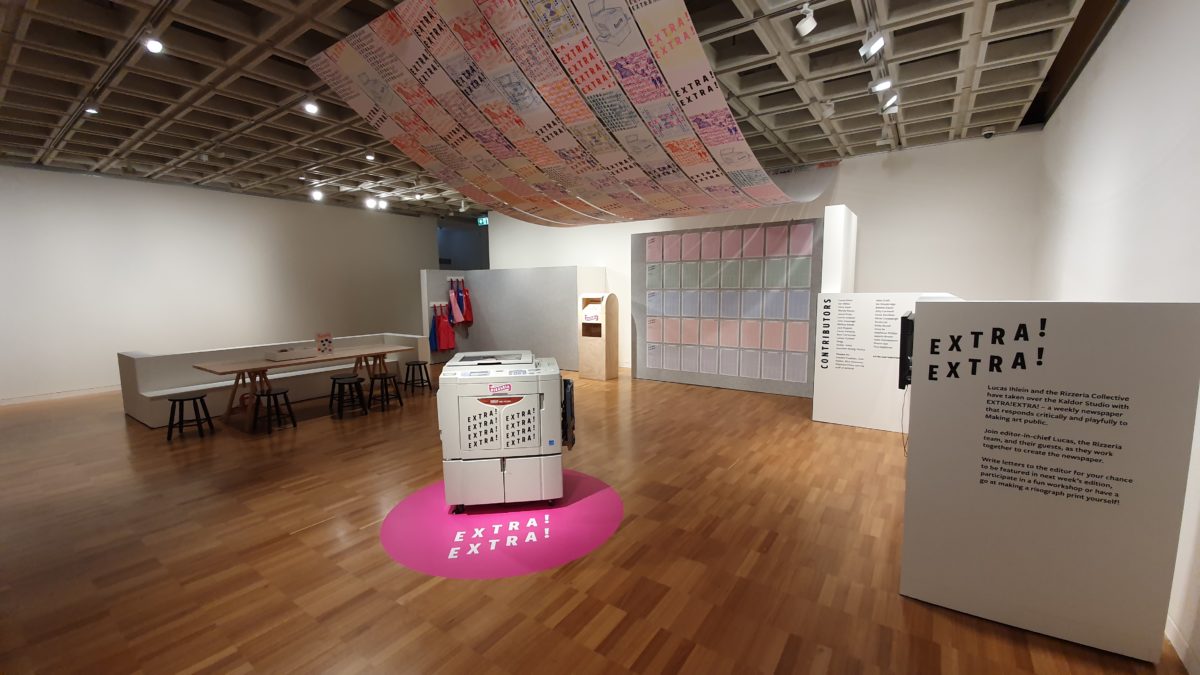
Studio at Extra! Extra!, 2019, Kaldor Public Art Projects, 50th Anniversary at Art Gallery NSW, https://www.extra-extra.press/wp-content/uploads/2019/11/20191108_150116-1200×675.jpg.

The studio at the Art Gallery of NSW with EXTRA!EXTRA! – a weekly newspaper which responds critically and playfully to Making Art Public, 9 Nov – 15 Dec, 2019. Each week, editor-in-chief Lucas Ihlein and special correspondent Ian Milliss were joined by special guest writers and artists, who worked with the Rizzeria team to print the newspaper in situ, EXTRA! EXTRA! -https://www.extra-extra.press/.

Some of the EXTRA! EXTRA!, team at the Art Gallery NSW, 2019, https://www.extra-extra.press/wp-content/uploads/2019/11/20191105_150209-1200×675.jpg.

The opportunity to be part of this project in 2019, was both exciting and terrifying. I had a very limited understanding of what I had agreed to do and had not even learned to catch the train alone from Wollongong to Sydney yet! I was going to give it my best shot and my Lecturer Lucas Ihlein, that had I nicknamed The Kat in the Hat, assured me everything would be fine. You can read all the great contributions and editions of EXTRA! EXTRA! at: https://www.extra-extra.press/.

Now, ordinarily this post would be about what I had learned through EXTRA! EXTRA! and some recording or interpretation of events or articles, at the Art Gallery of New South Wales, during the Kaldor Public Art Projects, 50th Anniversary of The Wrapped Coast (1969). There might even have been some analysis of the legacy The Wrapped Coast and Kaldor Public Art Projects have contributed to conceptual art in Australia. However, time has past and it seems more important in 2023, to recall the lesson I carry most from EXTRA! EXTRA!, while watching and learning from established, journalists such as Wendy Bacon, Chris Nash and Ian Milliss – have the courage of your convictions, speak, write or make about them because critical reflection is always necessary.

So, off I went and it was during this project, I first met the Two Wrapped Trees (1969) by Christo and Jeanne-Claude. I already knew I had a critical mind and being Aboriginal has a lot to do with it but I was afraid of causing offence. However, I was more compelled to write about the Two Wrapped Trees, so I did.

Image: Christo & Jeanne-Claude, Two wrapped trees 1969 (detail), two Eucalyptus trees, polyethylene, tarpaulin, rope, Gift of the John Kaldor Family Collection 2011. Donated through the Australian Government’s Cultural Gifts Program, © Christo Art Gallery NSW collection, https://www.artgallery.nsw.gov.au/media/collection_images/2/250.2011.a-b%23detail01%23S.jpg.

Here’s a some of what I wrote back then: … the first work that calls my attention is, The Wrapped Trees (1969) by Christo and Jeanne-Claude. Amid the chatter and giggling of school children, a long white box has been laid on the floor… it looks like a coffin without a lid. Inside the coffin-box, silent and still, are two trees, roots and branches wrapped and bound tight. This is land-art… the land has been brought from outside, wrapped and bound and brought inside. … I’m sure there’s a back story and a framework through which we are meant to view these trees. But  I’m sorry folks, I’m not feeling it. 

I am however, feeling very, very uncomfortable about these trees, wrapped and bound, brought from outside to inside, laid down in a long white box, like a coffin without a lid. I’m wondering was this feeling, this the artists’ intention? I want to know, were they alive when they were wrapped and bound, top and bottom? Were they pulled out of the earth by their roots for wrapping and binding? Did this artistic wrapping and binding suffocate and kill them?…  EXTRA! EXTRA!, Edition #2, 19.11.2019, https://www.extra-extra.press/edition-2/, https://www.extra-extra.press/2019/11/19/trees-in-coffins/.

To sign off, I’ll leave you with this – We know that the future often comes back to judge and critique the past and hindsight is 20/20… I guess, it’s what we do and how we manage that critique, that determines whether we’re just judging from the privileged position of the present or whether we can combine our lessons learned and make actions today, for a future we might to be proud of…

Thanx for dropping by,

Juundaal & The Trees

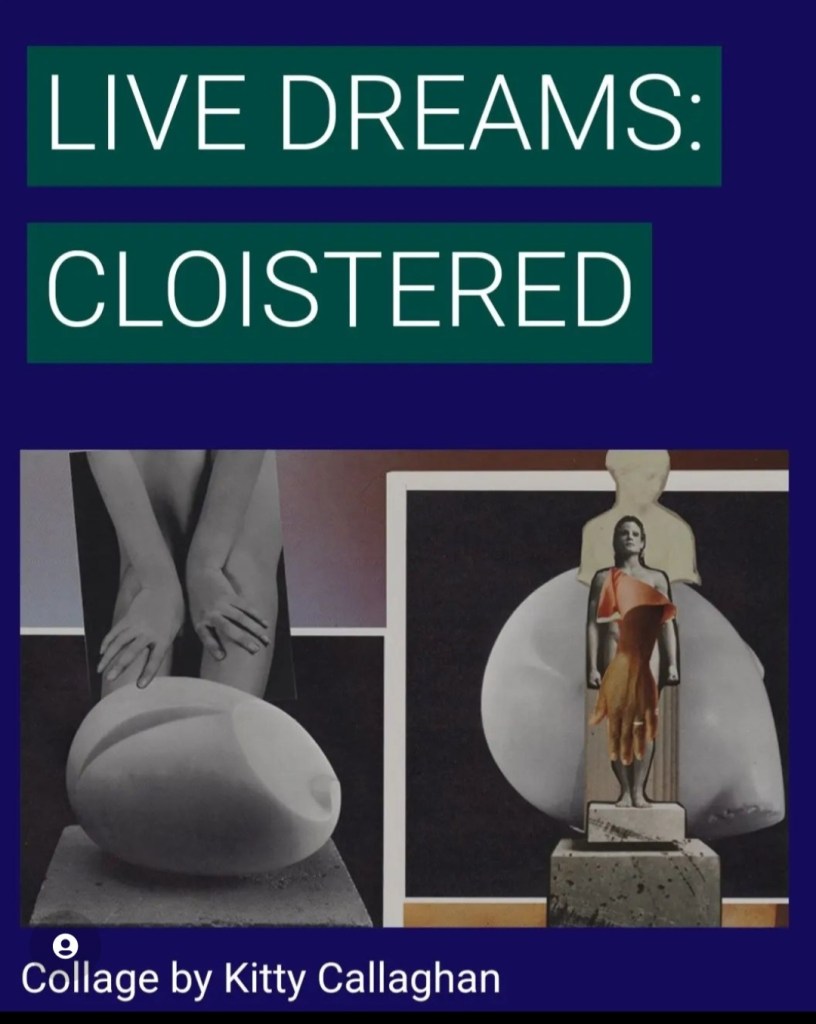
LIVE DREAMS: CLOISTERED

Curated by Alex Wisser, 2022, LIVE DREAMS at the Performance Space was an amazing opportunity for emerging and experimental works! I took the opportunity to give voice to Sister Everywhen in a performance called, Bound. So much gratitude to Alex and the LIVE DREAMS program for this opportunity!

Bound with Sister Everywhen, in is an attempt to personify, a deepest moment of consciousness and acceptance, inside Sister GlitterNullius as she realizes the full implications of human exploitation and destruction of nature, from the microbes, to fungus, insects, fish, bird, to mammal, freshwater, bitterwater to salt. In this moment, innocent, devastated and grieving she uses the last of her humanity, to articulate a last plea for nature, made in both Bundjalung and English languages.

Sister Everywhen, 2022, Photograph: Alex Wisser, taken on Dabee Wiradjuri Country.

My performance, Bound is the first public iteration of the experimental character, Sister Everywhen. The performance starts near the second hour of the CLOISTERED program!

Juundaal… X

Plastic-free Kandos, 2022!

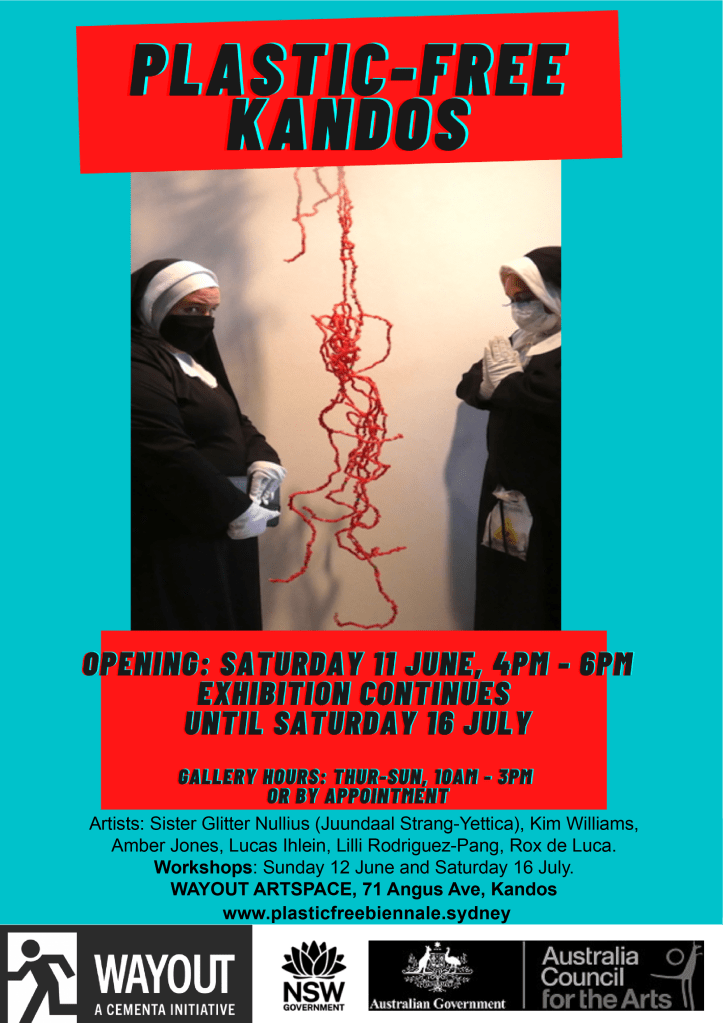
Plastic-free Kandos, 2022, promotional flyer.

Social engagement work, Plastic-free Biennale (2020) in NIRIN, Biennale of Sydney, has been reactivated after the impact of covid-19 and reconfigured to present Plastic-free Kandos, at the WAYOUT ArtSpace, 2022! I am thrilled to have the opportunity to work with Lucas Ihlein & Kim Williams again and have Sydney based Artist, Rox De Luca, join the adventure to tour the project to the Kandos community! Plastic-free Kandos presents an immersive and colourful exhibition of multi-sensory elements as we continue to address the everyday problem of plastic waste!

Image: One of the sculptural pieces by Rox De Luca, in Plastic-free Kandos, 2022, Image: Rox De Luca.

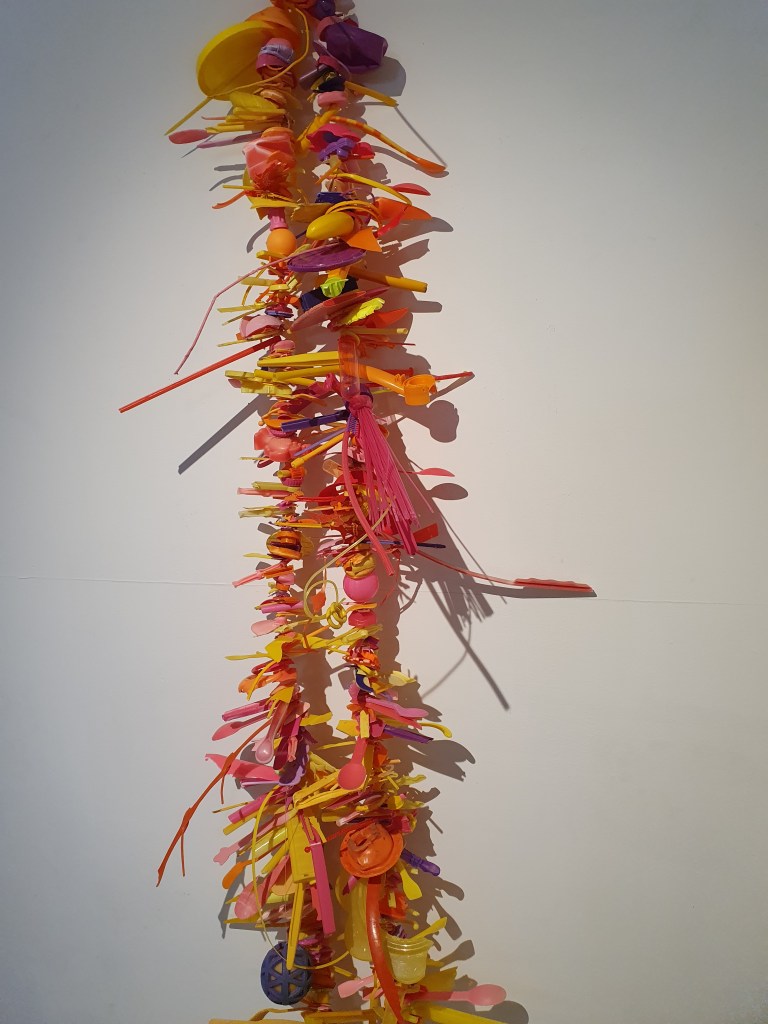
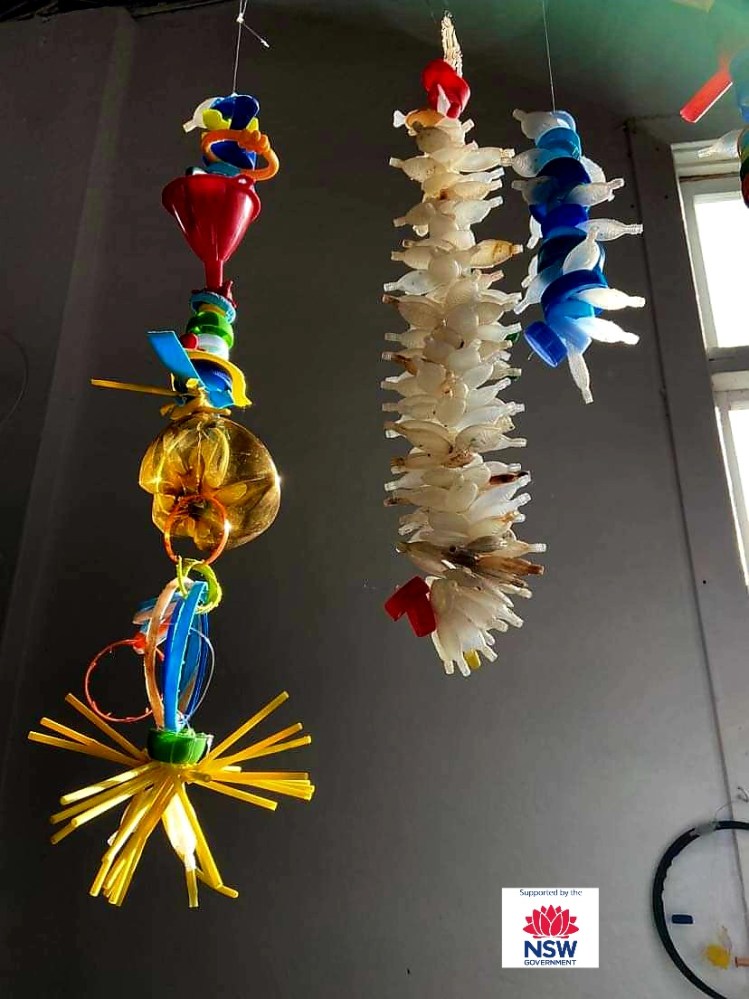
WAYOUT ArtSpace visitors can wander through an exhibition that engages with plastics, from the domestic to the global. Assemblages and sculptures, prints, photos, videos and live performances tackle our sticky relationship with this useful but monstrous family of materials. The Plastic-free Kandos exhibition spotlights Rox De Luca’s beautiful and ominous sculptural works constructed from plastic-waste, that she gleans from the East Sydney coastline. The exhibition also features installation works by Kim Williams and Lucas Ihlein, from Plastic-free Biennale, 2020. The project elements, all grappling with the plastic-waste problem; the Plastic-free Song performed by the Plastic-free Highlighters, video rap by MC McNanarchy, video, and sculptural installation by yours truly.

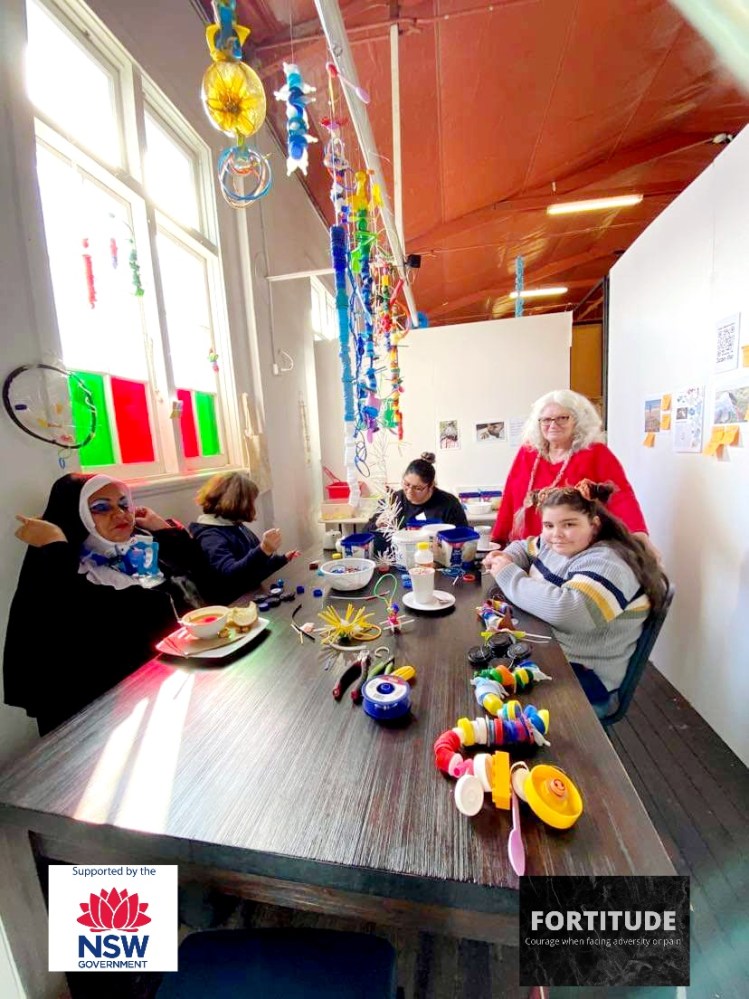
Image: Aunty Di Pirotta and her grandchildren in Rox De Luca’s workshop and creating with Sister GlitterNullius in WAYOUT ArtSpace, 2022, Image: Rox De Luca.

With community engagement workshops lead by Rox De Luca, opportunities to talk with the artists, bell-ringing blessings and damnations, up and down the main street of Kandos, joining the young ones in the workshops and prayerful interventions on opening night by the unapologetic Sister GlitterNullius!

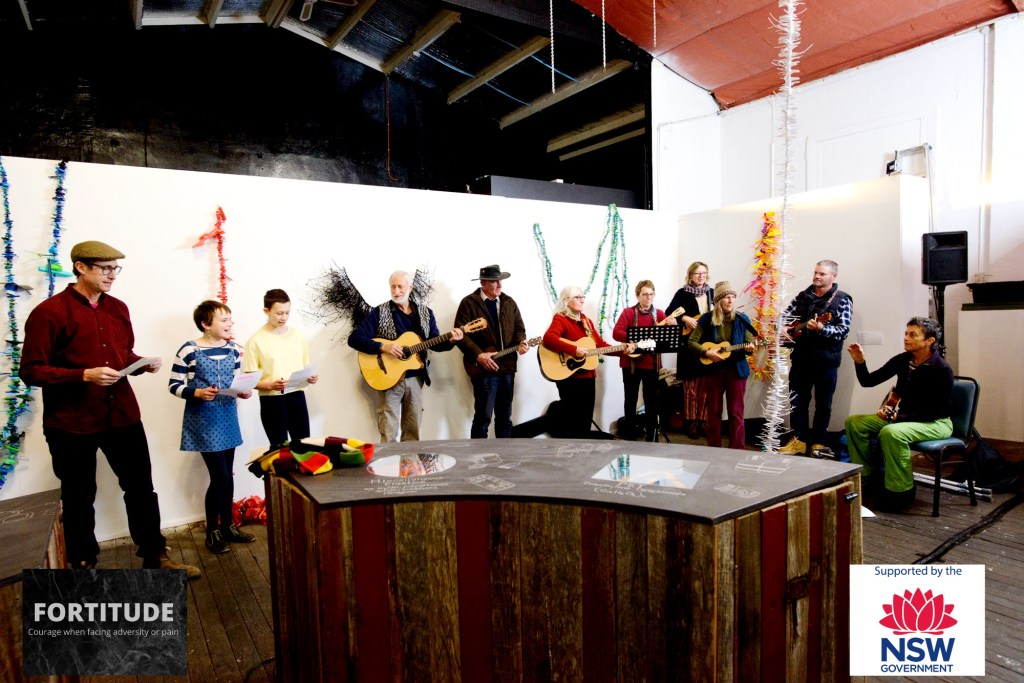
Image: The Kandos Ukulele Group performed a fabulous rendition of the Plastic-free Song on Opening Night! Image: Rox De Luca, 2022.

Uncle Peter Swain Welcomed the project and visitors onto Dabee Land and the Plastic-free Kandos, Acknowledgement to Country was read by Rox De Luca. The Kandos Ukulele Group performed a fabulous rendition of the Plastic-free Song and the then Minister for the Arts, Benjamin Franklin, opened the exhibition to a crowd of artists and the Kandos community!

The Honourable Minister for the Arts, Benjamin Franklin, kneels before Sister GlitterNullius at the Opening of Plastic-free Kandos, WAYOUT ArtSpace, Kandos NSW, Image: June Golland, 2022.

With community engagement workshops lead by Rox De Luca, opportunities to talk with the artists, bell-ringing blessings and damnations, up and down the main street of Kandos, joining the young ones in the workshops and prayerful interventions on opening night by the unapologetic Sister GlitterNullius!

Image: Community members sculptural artworks made from plastic-waste, in workshops lead by Rox De Luca at the WAYOUT ArtSpace, Kandos NSW, June 2022. Image: Rox De Luca.

Plastic-free Kandos: a group project, stemming from Kim Williams & Lucas Ihlein’s Plastic-free Biennale (2020) in NIRIN, the Sydney Biennale. It brought a group project from the city to the regional town of Kandos in NSW. It was an amazing opportunity to share with the local community, an exhibition of installations, social engagement workshops, performance and artist talks.

A snippet caught by June Golland, opening night Plastic-free Kandos, 2022, Sister GlitterNullius overindulging in that she hates to love best! X

There are many people to thank for getting this amazing project together – everyone who helped us install the works and promotional material, the Kandos community, Uncle Peter Swain, Aunty Di Pirotta; Videographer, Justin Hewitson, Songlark Cafe, Kandos High School, WAYOUT ArtSpace, Cementa Inc, CreateNSW, Arts Council Australia and Fortitude Illawarra who provided my NDIS Support Services to be part of this project.

Plastic-free Kandos, group project, 2022, CreateNSW, Acquittal Video, Videographer: Justin Hewitson.

Thanx for dropping by!

Your Friend, In & Out of Plastix,

Sister GlitterNullius X

CREATION: Day for Night, Performance Space, World Pride 2023

Images courtesy: Trina Benn, 2023.

Good afternoon & thanx for stopping by!

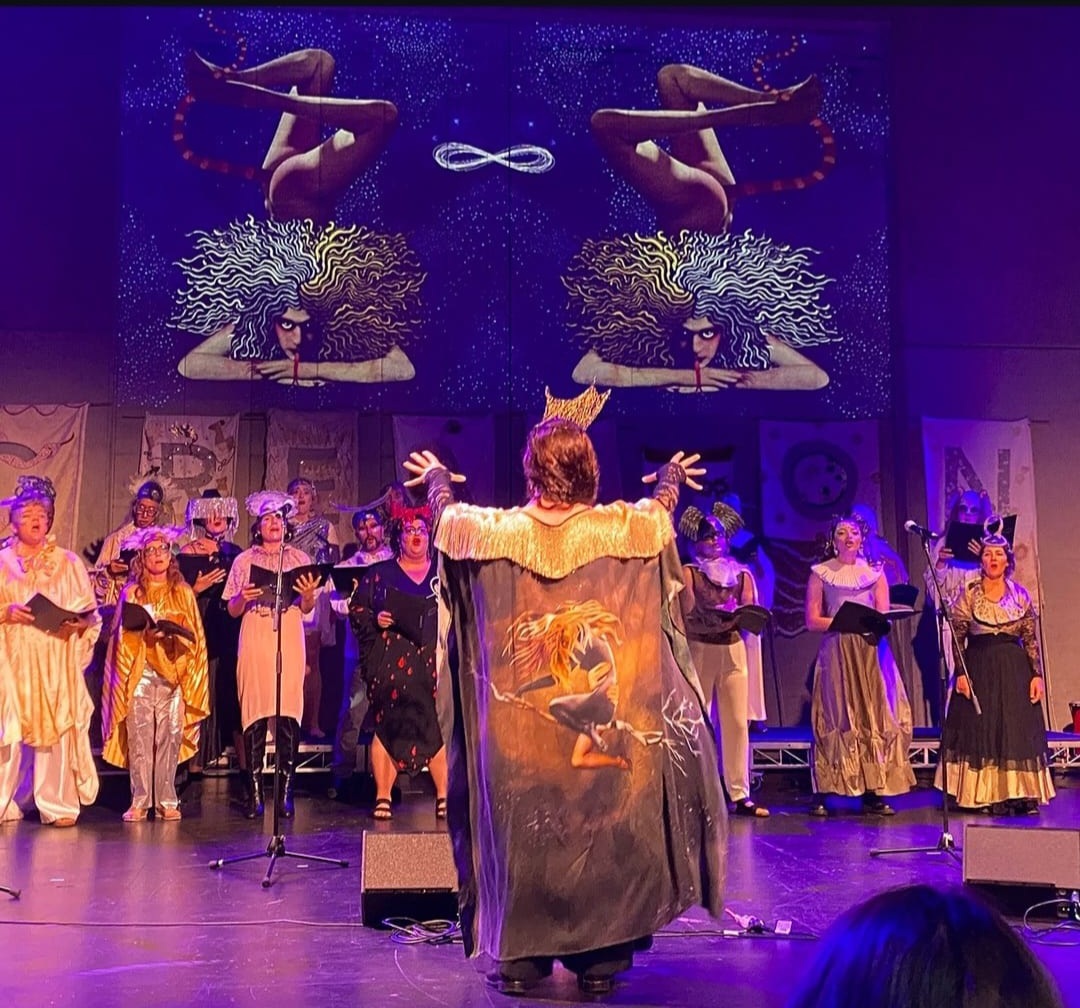
This year I had the privilege of performing with CREATION again, this time for World Pride at the Performance Space in Redfern. We’re lucky enough to have had, an audience member record a little footage, I’d like to share with you. What you can see is, the finale, the choir’s exit from the stage at the Performance Space. It’s a little blurry but I hope you get a feeling for the magnificent community we have become under the guidance of our Lead Artist, Deborah Kelly, Production Manager, Su Goldfish, Composer, Lex Lindsay and Choir Captain, Kit Spencer.

Video provided by Trina Benn, 2023, Creation Project, Day for Night, Sydney World Pride.

Below you’ll see a small capture of my character within the Creation Project. She’s a version of a type, Of Sister Everywhen (2022). This character is evolving toward her own destination… and will continue to manifest through the CREATION Project, over time.

I am so very privileged and grateful to have this ongoing relationship with the Project, the Choir and the guidance of Deborah, Su, Lex and Kit. I look forward to sharing more of my work with CREATION, with you.

Until next time, look after each other.

Juundaal

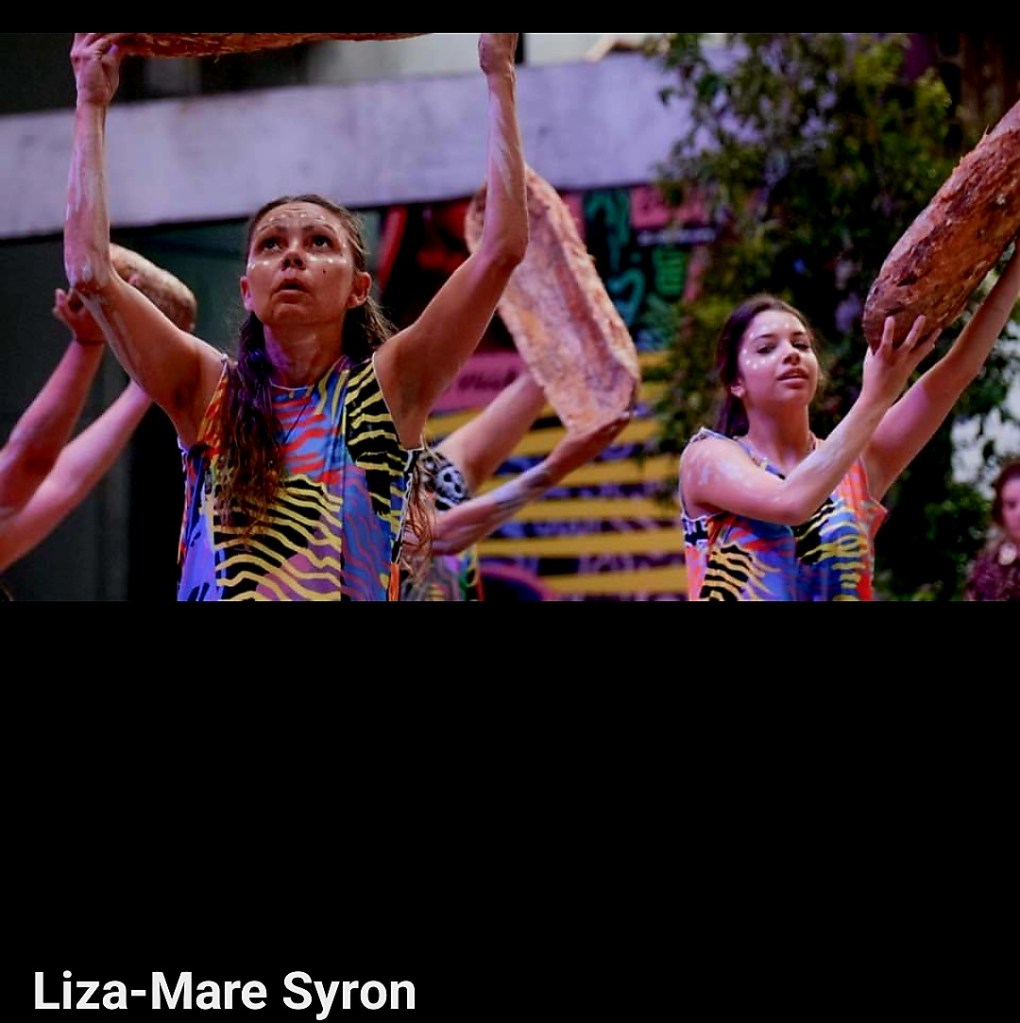
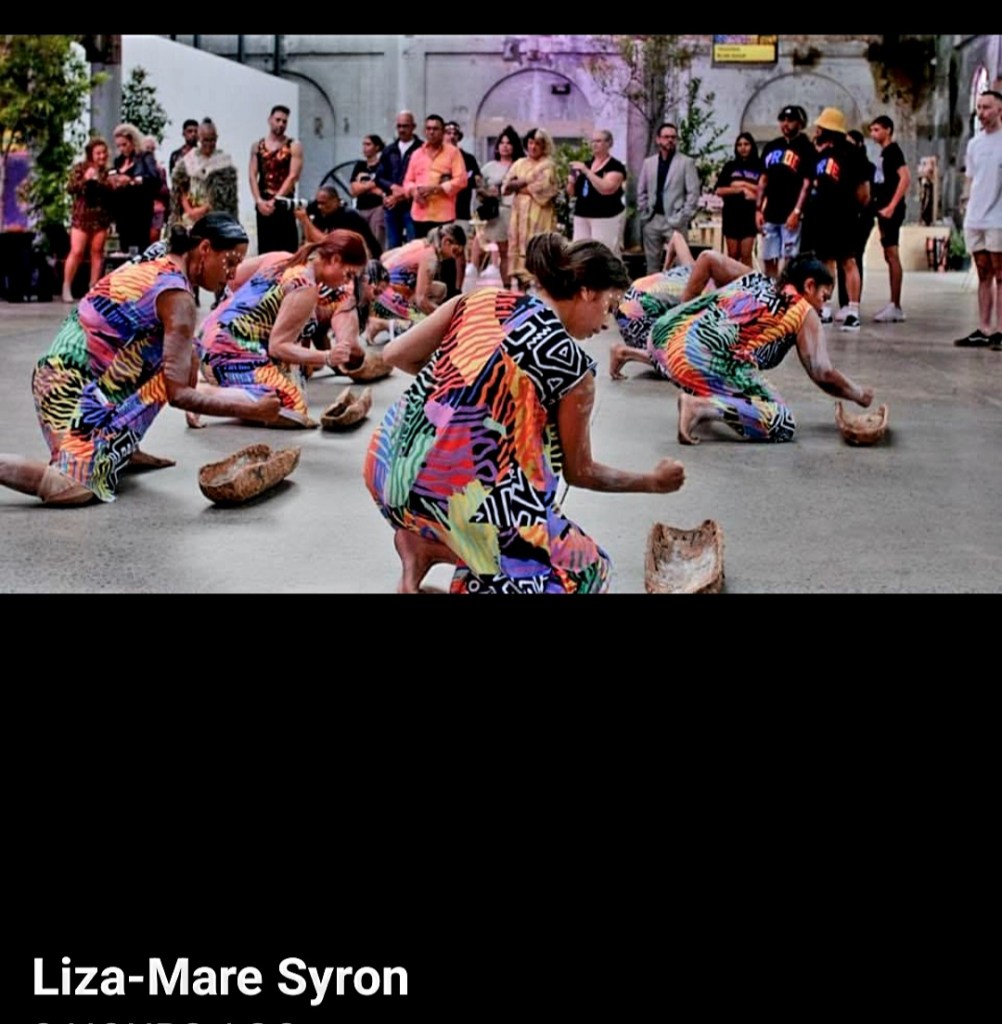
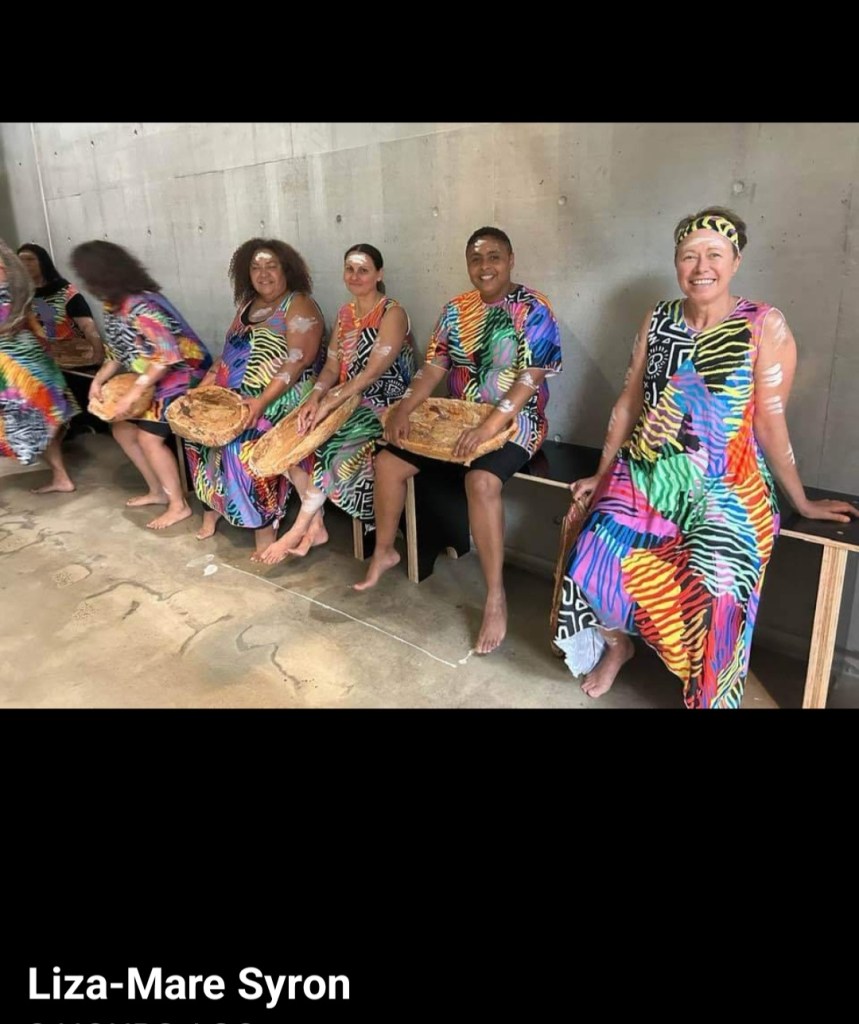
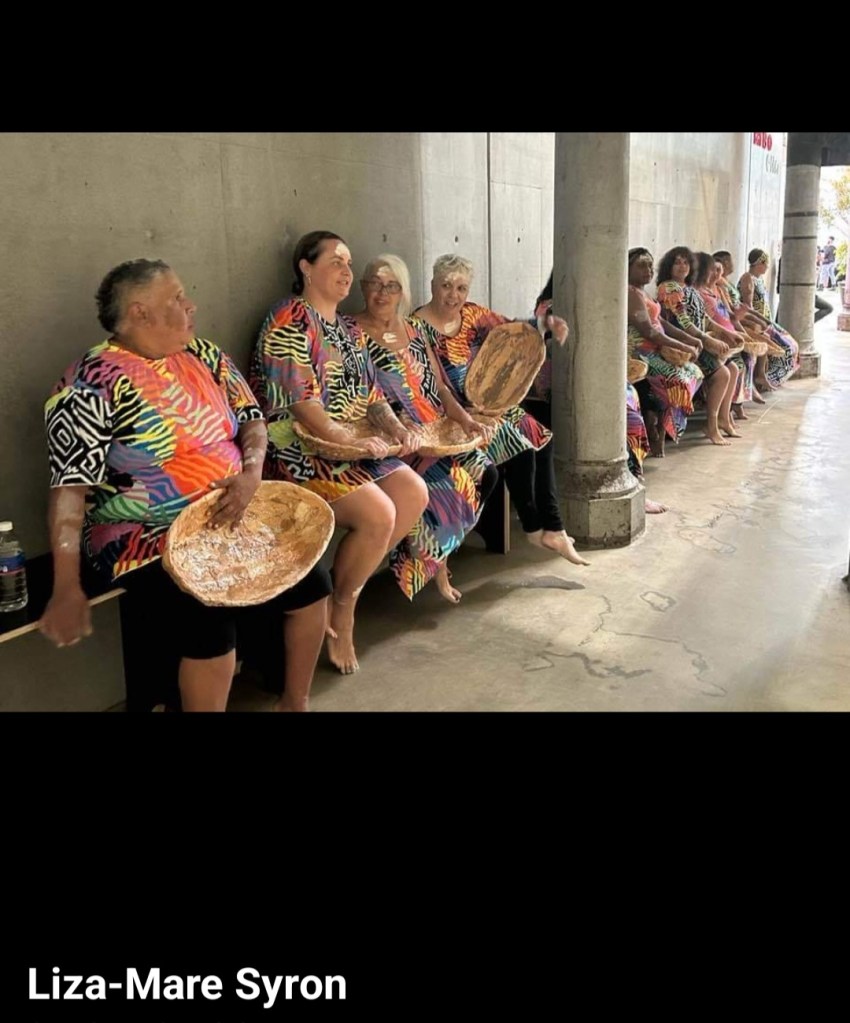
Koorie Wirguls & Jannawi Dance Clan: World Pride 2023

Good afternoon, thanx for stopping by!

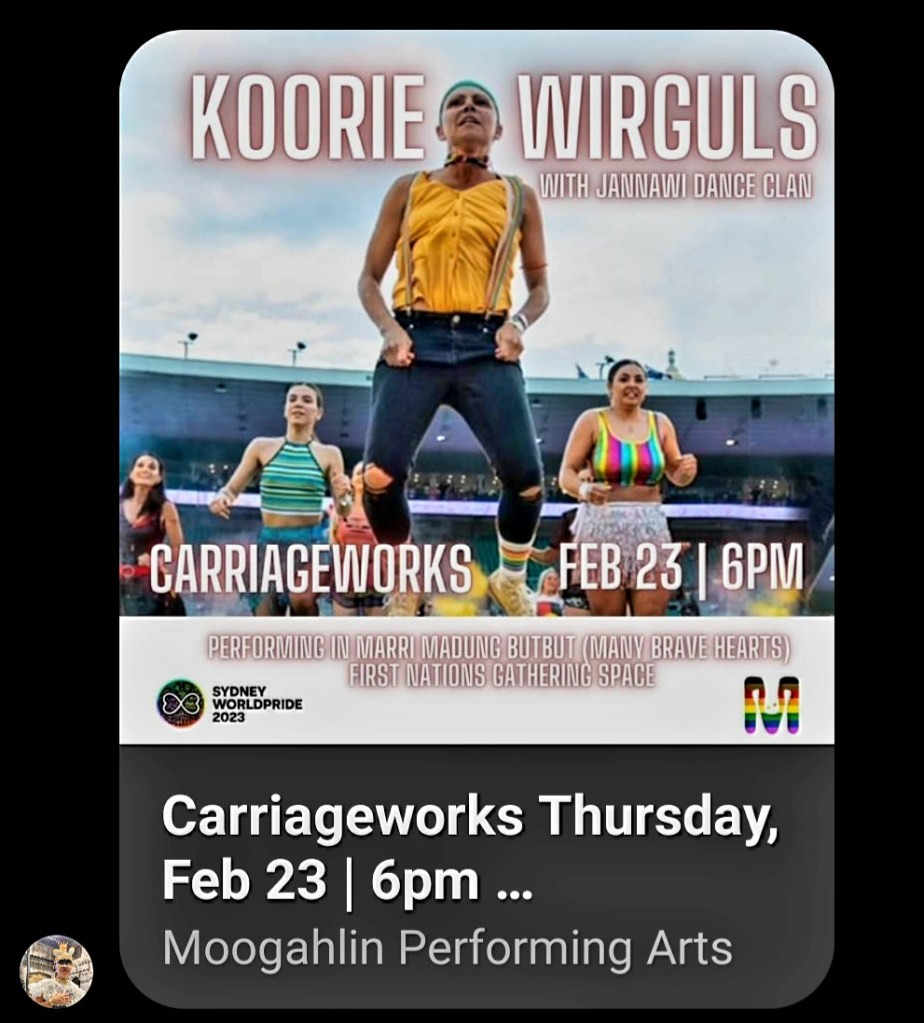
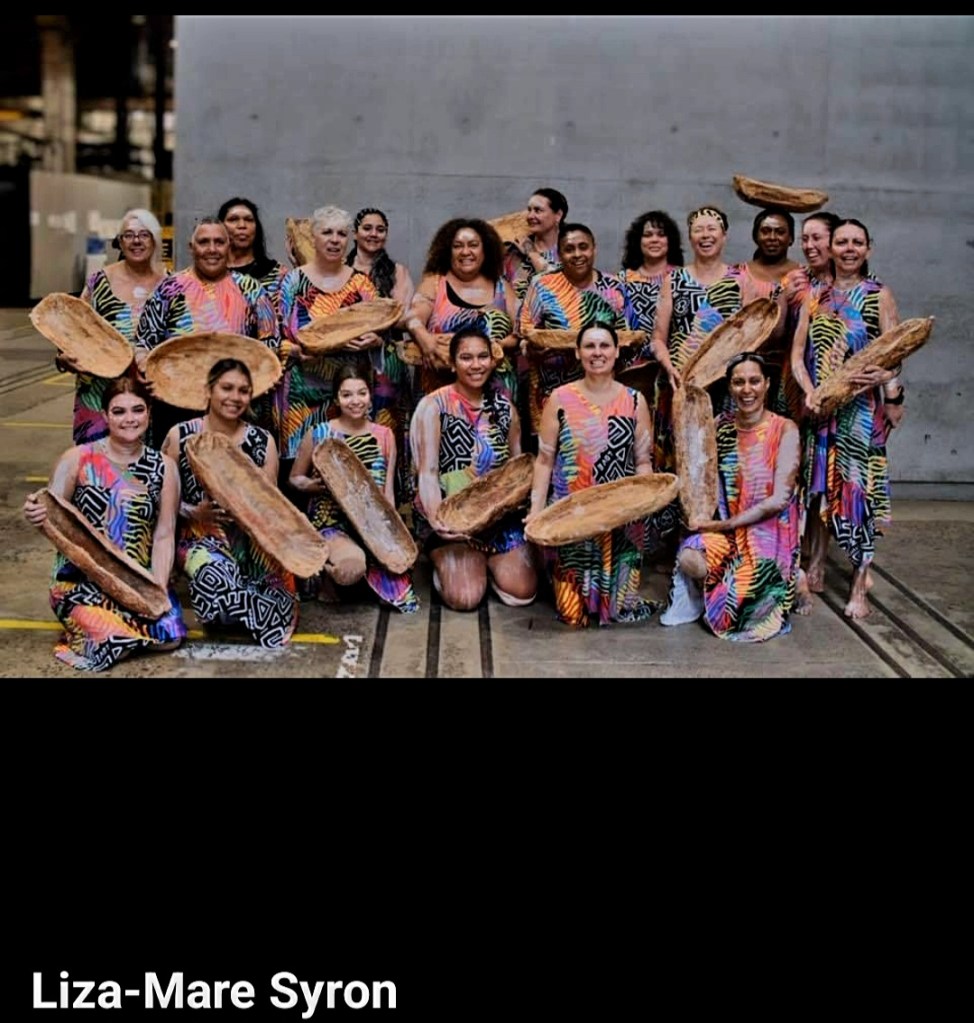
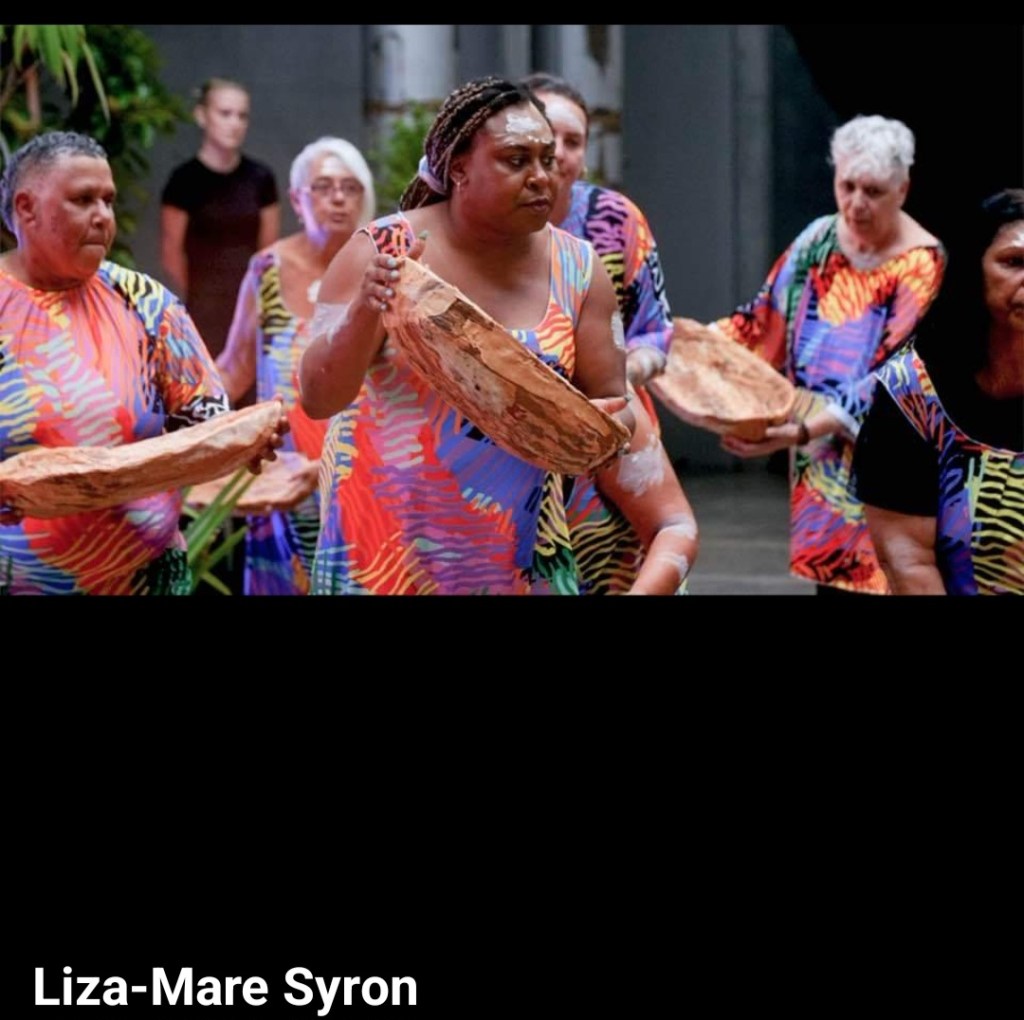
I get to contribute to some amazing gigs in the art world… Performing with Koorie Wirguls at this years World Pride is most definitely one of those! We rehearsed and rehearsed and then rehearsed some more to perform at the International Convention & Exhibition Centre in front of the International World Pride Conference, Sydney Town Hall: UltraViolet Party and the Performance Space, Eveleigh (aka Redfern).

My many thanx for Liza-Mare Syron, The Jannawi Dance Clan, Moogahlin Performing Arts and everyone for the opportunity to dance outside my comfort zone! Please enjoy the photographs!

Images: Courtesy Liza-Mare Syron, 2023.

Urgently arting, a savage world civil…

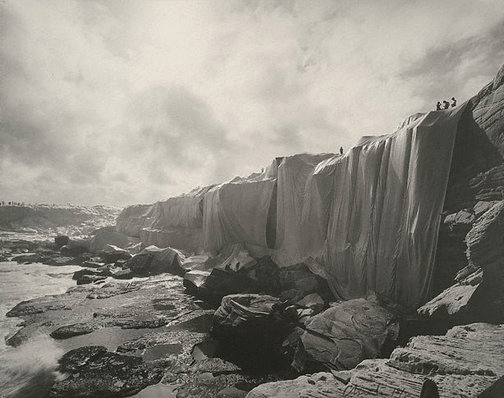
Image: The Wrapped Coast, One Million Square Feet, Little Bay, Sydney, Australia (1969), Christo & Jeanne-Claude, Image: Art Gallery NSW: https://www.artgallery.nsw.gov.au/collection/works/, accessed: 09.10.2022.

BCM 111 Global Media & Culture Assignment 2: Annotated Bibliography. Grade: 85/100.

Title: Urgently Arting a Savage World, Civil.

The Question: Discuss four key elements to building the rudimentary foundations of a major art project, to repatriate two eucalyptus trees from the Art Gallery of New South Wales to Country.

Introduction: New Articulation of an Old Idea

The purpose of this report is to build the foundations of a complex, collaborative, multidisciplinary, repatriation art project, for my performative character, Sister GlitterNullius. It also aims to provide evidence of traditional Indigenous ontologies and epistemologies within networked activism, and decolonised audience proximity, for engaging with Indigenous creative-cultural production. In part my repatriation project will investigate and interrogate complexities for arguing that natural objects are spirit-kin and part of Indigenous cultural ontologies. Therefore the two trees, archived within the Art Gallery of New South Wales collection, should be returned to Country. Specifically, I am developing a proposal to John Kaldor’s Public Art Projects program that two eucalyptus trees cut down and wrapped by artists, Christo (b.1935 – d.2020, Bulgaria) and Jeanne Claude (b.1935 – d. 2009, Morocco), in The Wrapped Coast (1969) need to be repatriated to Country, as an act of decolonised retro-accountability (Bacon, 2019; Strang-Yettica, 2019).

This annotated bibliography will report on activism longevity and social media activism. It will also exemplify audience activation for engaging with Indigenous creative-cultural expressions, through a decolonised lens. The selection of readings will expand upon themes of proximity for developing, audience proximity to Indigenous ontologies, epistemologies and nature. To support these concepts, this report will outline one approach for understanding nature as spirit-kin within Indigeneity.

Centering Nature as Spirit-Kin in the Anthropocene: Todd, Zoe, 2015 Indigenising the Anthropocene, Art in the Anthropocene: Encounters among aesthetics, politics, environments & epistemologies, ch.7, p.241-255, Open Humanities Press.

In this chapter, Zoe Todd (2015) attests that the globalised world provides networked platforms by which Indigenous people align with other First Nations cultures in challenging western notions of the human-to-nature relationship. Internet platforms such as social media, deliver Indigenous ontologies and epistemologies addressing the environmental urgency of the Anthropocene. To this end, Todd explains that, western ideological and epistemological divisions between humans and nature need to be dismantled. Furthermore, Indigenous knowledge that the land is alive with types of consciousness, must be included within our understanding of environmental urgency. This agency and consciousness in nature gives rise to acknowledging that nature therefore, also has spirit. Todd determines that, in this recognition we are obligated to understand that humans are spirit-kin with nature. Therefore it is our responsibility to align ourselves equally with the environment and provide advocacy and protection to our non-human kin. This chapter calls for Indigenising the Anthropocene and recontextualising nature to the centre of our fight against environmental demise.

Engaging with Indigenous Cultural Artistic Expression: Audience Activation to Decolonised Proximity: Schultz, Tristan B, 2013, Encountering Aboriginal Cultural Expressions: Peace, Proximity, Obligation & Responsibility, Centre for Tourism, Leisure & Work, Southern Cross University, Lismore, NSW,  academia.edu, accessed: 06.10.2022.

This paper obligates the audience to activate itself within proximity to Indigenous cultural ontologies and epistemologies when engaging with Indigenous cultural-creative production. It is important to approach creative work with an understanding that more complex sets of logic are present, other than western linear ways of knowing and being. In discussing this extended idea of proximity, this paper outlines the need for the audience to undertake its responsibility to educate and decolonise the lens through which they receive Indigenous creative-cultural expressions. At the risk of encountering a neo-colonial gaze, the authors advance a number of strategies for an active audience to “delink” (p.21) from the colonised frameworks of binary, oppositional definitions when engaging with Indigenous cultural expressions.

The authors argue that Indigenous cultural production, as a mediated space within contemporary culture, requires the audience to move toward a decolonised socio-political culture of proximity. Then the signification is received from the re-coded signs revealed within Indigenous creative-cultural expressions. One example of this proximity, is not a cultural proximity of sameness identification but of engaging and being for the Other. This one example allows for diversity when underpinned by an active audience approach of self-responsibility and equality when engaging with Indigenous cultural expressions.

Image: The Wrapped Coast, One Million Square Feet, Little Bay, Sydney, Australia (1969), Christo & Jeanne-Claude, Image: Art Gallery NSW: https://www.artgallery.nsw.gov.au/collection/works/, accessed: 09.10.2022.

Social Media Meets Yarning Circle Culture: Carlson, Bronwyn & Frazer, Ryan, 2018, Yarning Circles & Social media Activism, Media International Australia, Vol.169(1), p.43-53, Sage Publications, DOI:10.1177/1329878X18803762, accessed: 09.10.2022.

This article reflects upon Indigenous cultural practice of yarning and yarning circles, within the social media activism context. It reports that traditional and contemporary yarning circles serve multiple socio-cultural purposes. Yarning circles encompass oral storytelling, collective democracy, learning and problem solving with equal care. The paper explains that yarning circles ground culture and kinship ties through meeting and oral communication, simultaneously underpinning education, care, obligation and cultural practice into everyday life.

The paper outlines that yarning circles function similarly in social media activism as it does in physical environments. The authors reflect upon the role of yarning circles in activism and the online community of activist movements through the 2015 symposium Reterritorialising Social Media: Indigenous People Rise Up. They assert that yarning circles exist in social media activism and various Indigenous cultures around the world, forming  part of global Indigeneity and serving similar care and solidarity functions. The authors claim that, the practice of yarning and yarning circles online, provide a decolonised arena for political collectivity, supporting cultural, activist and ally proximity around the world. The essay states that online yarning has become an important aspect of Indigenous online creative, cultural and socio-political communications. That it contributes to the resilience of local and global activist communities, while concurrently inserting traditional practices into the networked world, an ancient mediated space operating within modern environments.

Creating Sustainability in Activism: Cineas, Fabiola, 2020, The protests feel different because they’re shifting public opinion: To sustain the current anti-racism movement, look to the past, says Professor Megan Ming Francis, blog entry, Vox Media.

This blog contribution is an interview with Professor of Political Science, Megan Ming Francis discussing elements for long term, successful activist movements. It focuses on the question, how Black Lives Matter activists can protract the velocity of the movement and encourage people to examine entrenched systemic racism. Professor Francis outlines five pivotal factors that include, public education, recognition for the mechanisms of protest, how they shift public opinion and protest beyond the streets. Also listed are the need for change within political and legal institutions as well as, developing means for maintaining protest movements. Various strategies for the sustainability of the Black Lives Matter movement, in conjunction with street protests, are drawn from strategies deployed by previous movements. Professor Francis indicates that applications such as petitions and securing court decisions, not only complement protest in shifting public opinion but infiltrate institutions embedded with systemic racism. Professor Francis also highlights another key element in protecting Black Lives Matter longevity, and that is the global, intergenerational and cross-racial alliances between its members.

Image: The Wrapped Coast, One Million Square Feet, Little Bay, Sydney, Australia (1969), Christo & Jeanne-Claude, Image: Art Gallery NSW: https://www.artgallery.nsw.gov.au/collection/works/, accessed: 09.10.2022.

Assessment: Spirit-kin Advocacy is Key:

Cineas (2020)  furnishes my project with strategies for shifting public opinion and achieving its longevity through education, formal processes such as court systems and building alliances across audiences, generations, cultures and disciplines. The Carlson and Frazer (2018) reading demonstrates the effective transfer and practice of yarning and yarning circles, as ancient cultural ontologies and epistemologies activated within social media activism. While Schultz (2013) comprehensively offers numerous points of entry for decolonising the audience lens and engagement with Indigenous cultural expression. The paper calls for audiences to proactively and responsibly engage with Indigenous cultural and creative expression by locating themselves within proximity of Indigenous ontologies and epistemologies as equal allies. While Zoe Todd’s chapter (2015) Indigenising the Anthropocene, describes and explains Indigenous concepts pertaining to non-human agency, spirit and kinship rights to priority advocacy and protection from and by humans. Todd (2015) articulates these principles and beliefs that are very similar to those taught to me and that motivate my undertaking a large-scale, complex, repatriation art project.

As building blocks for this repatriation project, each of these readings clearly evidence significant, active elements of Indigenous ontologies and epistemologies within the global networked world. They invite and situate allies and audiences to reposition their experiences within proximity to a more proactive and complex engagement with Indigenous cultural practices, creative expression and activism. All the essays call for decolonising institutions and ideologies that prioritise some kin above others. They all call for action against oppression, injustice and the urgent need for collaborative advocacy, protection and equality for less powerful kin. Similarly, each reading illuminates the importance of trustworthy, responsible relationships across species, cultural, geographical, political and internet borders (Carlson & Frazer, 2018; Cineas, 2020; Schultz, 2013; Todd, 2015).

In relation to the trees, archived within the Art Gallery of New South Wales’ collection, it seems logical and necessary that my art project is activated within various relational and networked environments. Equally importantly, this repatriation art project must be responsibly culturally and collaboratively informed; decolonisation, activism and advocacy simultaneously. In closing, these readings will inform the principles for my repatriation project, to return two trees out of a gallery to Country.  (Carlson & Frazer, 2018; Cineas, 2020; Schultz, 2013; Todd, 2015).

Reference List:

Bacon, Wendy, 2020, Telling the wrapped Coast Story, blog article, https://www.wendybacon.com/2020/telling-the-wrapped-coast-story, Extra! Extra!, Making Art Public, 50th Anniversary of Kaldor Art Projects, Art Gallery New South Wales, http://www.extra-extra.press/2019/11/26/telling-the-wrapped-coast-story/#more-489, accessed: 22.09.2022.

Carlson, Bronwyn & Frazer, Ryan, 2018, Yarning Circles & Social media Activism, Media International Australia, Vol.169(1), p.43-53, Sage Publications, DOI:10.1177/1329878X18803762, accessed: 09.10.2022.

Cineas, Fabiola, 2020, The protests feel different because they’re shifting public opinion: To sustain the current anti-racism movement, look to the past, says Professor Megan Ming Francis, blog entry, Vox Media, https://www.vox.com/2020/6/26/21301066/public-opinion-shift-black-lives-matter, accessed: 06.10.2022.

Schultz, Tristan B & Des, 2013, Encountering Aboriginal Cultural Expressions: Peace, Proximity, Obligation & Responsibility, Centre for Tourism, Leisure & Work, Southern Cross University, Lismore, NSW,  academia.edu, accessed: 06.10.2022.

Strang-Yettica, Juundaal, 2019, Trees in coffins, Extra! Extra!, Making Art Public, 50th Anniversary of Kaldor Art Projects, Art Gallery New South Wales, http://www.extra-extra.press/2019/11/19/trees-in-coffins/, accessed: 09/10/2022.

Todd, Zoe, 2015, Indigenizing the Anthropocene, Art in the Anthropocene: Encounters Among Aesthetics, Politics, Environments & Epistemologies, Ch.7, p.241-254, Davis, Heather; Turpin, Etienne (eds.), Open Humanities Press, London, United Kingdom.

Bibliography:

Banaji, S & Moreno-Almeida, C, 2020, Politising Participatory Culture at the Margins: The Significance of Class, Gender & ONline Media for the Practices of Youth Networks in the MENA region, Global Media & Communications, Vol.17(1), p.121-142, DOI: 10.1177/1742766520982029, access: 09.10.2022.

Braidotti, R, 2006, Posthuman, All Too Human: Towards a New Process Ontology, Theory, Culture & Society, Vol.23(7-8), p.197-208, DOI:10.1177/0263276406069232, accessed: 05.10.2022.

Davis, Heather & Turpin, Etienne, 2015, Art in the Anthropocene: Encounters Among Aesthetics, Politics, Environments & Epistemologies, Creative Commons, Open Universities Press, London.

Gilbert, Helen; Phillipson JD & Raheja, Michelle, (eds.), 2017, In the Balance: Indigeneity Performance & Globalisation, Liverpool University Press, United Kingdom, accessed: 05.10.2022.

Haraway, Donna, 2018, Staying with the Trouble for Multispecies Environmental Justice, Dialogues in Human Geography, Vol.8(1), p.102-105, Sage Publications, UK.

hooks, bell, Black Looks: race & representation, 1992 & 2015, South End Press, Boston, US.

Ksiazek, T & Webster, JG, 2008, Cultural proximity & Audience Behaviour: The Role of Language in Patterns of Polarisation & Multicultural Fluency, Journal of Broadcasting & Electronic Media, Vol.52, No.3, p.485-503, DOI: 10.1080/08838150802205876.

Kindsfather E, 2020, From Activism to Artistic Practice: (Re) Imagining Indigenous women’s Labour: Activism in Contemporary Art, Graduate Student Conference, Essay Award, RACAR, Vol. 47:1, p.58-71, https://doi.org/10.7202/1091821ar, accessed: 12.09.2022, 05.10.2022.

Phipps, P, 2009, Globalisation, Indigeneity & Performing Culture, Local-Global: Identity, Security, Community, Vol.6, p.28-48, DOI: 10.3316/informit.107108986596288, accessed: 06.10.2022.

Moreton-Robinson, Aileen (ed.), 2004, Whitening Race: Essays in social and cultural criticism, Aboriginal Studies Press, Canberra, Australia.

Wilson S, 2008, Research is Ceremony: Indigenous Research Methods, Fernwood Publishing, Nova Scotia.

End