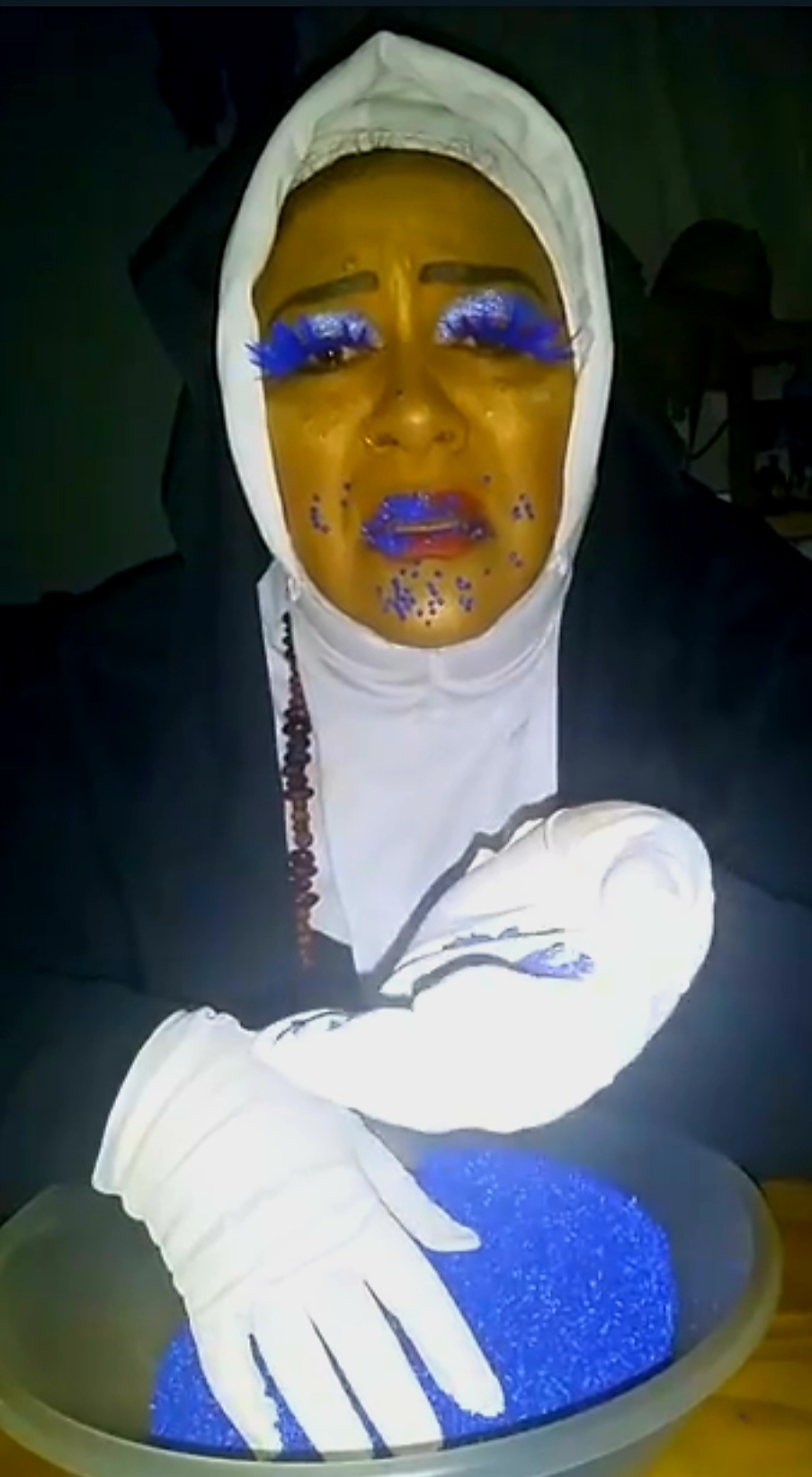
Sister GlitterNullius: Empathy. X

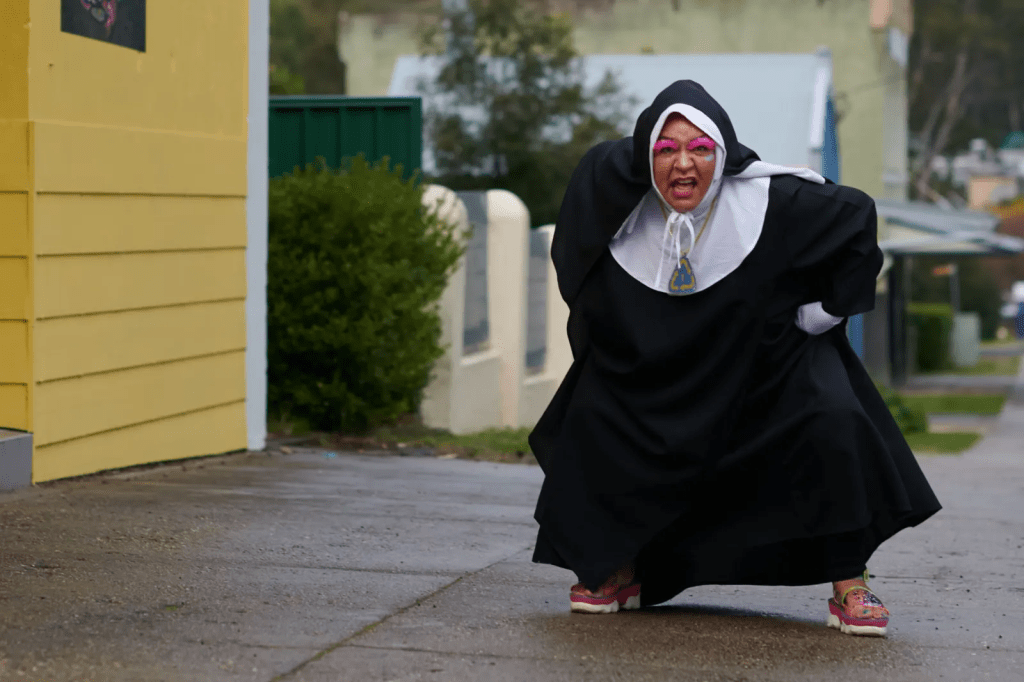
Sister GlitterNullius: Empathy, 2022, Video: Justin Hewitson, Edits: Jesse Tyssen, Direction: Juundaal. Filmed on Dabee-Wiradjuri Land, The Common, Rylstone, NSW.

BCM 111 Global Media & Culture Assignment 3: Empathy, 2022, Video Presentation & Script. Grade: HD 90/100.

Concepts: 1. Networked, Indigenous Identity & Indigenous Art Activism, 2. Environmental Art Activism Intersectional Environmentalism, 3. Cultural Proximity, 4. Audience Access & Activation: Developing non-Indigenous Proximity & Engagement with Indigenous Cultural
Expression.

Explanatory Note:
Video: Justin Hewitson recorded the video raw footage, from time spent on Dabee-Wiradjuri Country, The Common at Rylstone, NSW, during our Plastic-free Kandos project, June 2022. I directed the shoot, with edits for this Assignment by Jesse Tyssen.

For the purpose of this Assignment submission, the citations are those that respond to and expand upon the Subject and its topics. In part, the purpose of this video is also to articulate activism and advocacy for the equality and spirit-kinship with non-humans, and building a large, collaborative, repatriation art project, for my performative character, Sister GlitterNullius. Empathy (2022), represents a culmination of my performances this year and future goals. It will be posted to social media platforms and as such, like Sister GlitterNullius, will exist within the global networked, contemporary art context and is itself a conduit of activism and advocacy. That the script is also offered with its English translation, simultaneously, an act of decolonised invitation and activism. (Carlson & Frazer, 2018; Cineas, 2020; Davis & Turpin, 2015; Gates, 2017; Gilchrist, 2016; Gilbert et al, 2017; Hall, 1997; hooks, 1992; Moraes, 2014; Schultz et al, 2013; Todd, 2015).

Script Note:
For the ease of translation and reading, the Bundjalung script is in Italics, followed by the English translation in plain font. Disclaimer: I am a student of my Bundjalung language. All Bundjalung script attributions are cited to my Bundjalung familial-cultural learning, Muurrbay Aboriginal Language & Culture Co-operative, 2015, Yugambeh-Bundjalung Dictionary, https://bundjalung.dalang.com.au/plugin_wiki/index.html and Dez Marsh, Language Coach.

Empathy Script:

Jingiwahlu wahlu, Jingiwahlu wahlu. Hello. I hope your spirit is well.

Nyanyah nyarri manya! I am of and belong to native land.

Nyanyah Minjungbal, Yugambeh mibin. I am of Country, Minjungbal, Yugambeh nations.

Nigh yiggen yuggen manya gah. My name is native land (Cutter-Mackenzie-Knowles et al, 2020; Davis & Turpin, 2015; Gilchrist, 2016; Hall, 1996 & 1997; hooks, 1992; Gilbert et al, 2017; Moreas, 2014).

Ngali na jugun. We belong to this Country (Muurrbay Co-op., 2015).

Ngali garma mala jugun. We look after this Country (Muurrbay Co-op., 2015).

Wana janma mala gunu gala jugen. Don’t do wrong around this Country (Muurrbay Co-op., 2015).

Ngali wana jana mala jugen. We don’t harm this Country here (Muurrbay Co-op., 2015).

Ngali na mala jugen. We belong to this Country (Muurrbay Co-op., 2015).

Nigh yiggen yuggen nirijabah, birin gah! My name is Saltwater (Cutter-Mackenzie-Knowles et al, 2020; Davis & Turpin, 2015; Gilchrist, 2016; Hall, 1996 & 1997; hooks, 1992; Gilbert et al, 2017; Moreas, 2014; Todd, 2015). 

Ngay garni yuggen, birin. I am from and belong to Saltwater (Cutter-Mackenzie-Knowles et al, 2020; Davis & Turpin, 2015; Gilchrist, 2016; Hall, 1997; hooks, 1992; Gilbert et al, 2017; Moraes, 2014; Todd, 2015). 

Nigh yiggen yuggen gali gah! My name is tree (Cutter-Mackenzie-Knowles et al, 2020; Davis & Turpin, 2015; Gates, 2017; Gilchrist, 2016; Hall, 1997; hooks, 1992; Gilbert et al, 2017; Moraes, 2014; Todd, 2015).

Ngay garni yuggen gali. I am from and belong to tree (Cutter-Mackenzie-Knowles et al, 2020; Davis & Turpin, 2015; Gates, 2017; Gilchrist, 2016; Hall, 1997; hooks, 1992; Gilbert et al, 2017; Moraes, 2014, Todd, 2015).

Neither human or non, can you welcome me (Davis & Turpin, 2015; Gates, 2017; Gates, 2017; Phipps, 2009; Schultz, 2013; Todd, 2015)? 

Can you see me? Why can’t you see me (Davis & Turpin, 2015; Gates, 2017; Gilbert et al, 2017; Hall, 1997; Ksiazek & Webster, 2008; Moraes, 2014; Phipps, 2009; Schultz, 2013; Todd, 2015)?   ?

Don’t speak. Be Quiet. We are not child in this hypocrisy (Davis & Turpin, 2015; Gates, 2017; Hall, 1997; Ksiazek & Webster, 2008; Moraes, 2014; Phipps, 2009; Schultz, 2013; Todd, 2015)?  

No return. Can’t go back. Go back. Stop going forward (Davis & Turpin, 2015; Gilchrist, 2016; Phipps, 2009; Schultz, 2013; Todd, 2015)!

Take me Home! Take me yamba! Take me home (Davis & Turpin, 2015; Gates, 2017; Gilchrist, 2016;Hall, 1997;  Moraes, 2014; Phipps, 2009; Schultz, 2013; Todd, 2015)!

Why won’t you take me Home? Why can’t I go Home (Davis & Turpin, 2015; Gates, 2017; Gilchrist, 2016; Hall, 1997; Moraes, 2014; Phipps, 2009; Schultz, 2013; Todd, 2015)?

Everywhen ago and now we are here. Look where we are! One way, one way! I keep telling you, we are going in only one way! Stop going that way! Please stop going forward (Davis & Turpin, 2015; Gates, 2017; Hall, 1997; Gilchrist, 2016; Moraes, 2014; Phipps, 2009; Schultz, 2013; Todd, 2015)!

This when, other whens and everything is everything (Davis & Turpin, 2015; Gates, 2017; Gilchrist, 2016; Phipps, 2009; Schultz, 2013; Todd, 2015).

Everywhen ago, we let it all go,now we are here (Davis & Turpin, 2015; Gates, 2017; Gilbert et al, 2017; Gilchrist, 2016; Hall, 1997; Ksiazek & Webster, 2008; Phipps, 2009; Schultz, 2013; Todd, 2015).

I don’t think I am supposed to be here. You do not belong here. These do not belong here (Davis & Turpin, 2015; Gates, 2017; Gilbert et al, 2017; Hall, 1997; Ksiazek & Webster, 2008; Moraes, 2014; Phipps, 2009; Schultz, 2013; Todd, 2015). 

Where do you belong? I’m sure I don’t belong here (Gates, 2017, Gilbert et al, 2017; Ksiazek & Webster, 2008; Hall, 1997, hooks, 1992, Moraes, 2014).

What is your relationship here (Gates, 2017; Gilbert et al, 2017; Hall, 1997; hooks, 1992; Ksiazek & Webster, 2008; Moreas, 2014; Phipps, 2009; Schultz, 2013; Todd, 2015)?

We are already there, it’s too late (Davis & Turpin, 2015; Gilchrist, 2016; Phipps, 2009; Schultz, 2013; Todd, 2015). 

I am your monster. Your infection. your monster, your mistakes (Gates, 2017; Gilbert et al, 2017; Hall, 1997; hooks, 1992; Ksiazek & Webster, 2008; Moreas, 2014; Phipps, 2009; Schultz, 2013  .

Forward is not destiny, surely? How are we going to escape to survive (Davis & Turpin, 2015; Gates, 2017; Gilchrist, 2016; Hall, 1997; Phipps, 2009; Schultz, 2013; Todd, 2015)?

This deformity, my deformity is yours, ours both. I was birin, now jagur. I was saltwater, now stranger Cutter-Mackenzie-Knowles et al, 2020; Davis & Turpin, 2015; Gates, 2017; Gilchrist, 2016; Hall, 1997; hooks, 1992; Gilbert et al, 2017; Moraes, 2014, Todd, 2015).

Can’t get in, can’t get out, jagur -stranger. Can’t get out to get in, nor in to be bound. Can’t get in to get out, jagul -native land nor be free, not out to get in, no free, no gali – no tree, no birin – no saltwater, no yamba – no home, no jagul – no native land…Cutter-Mackenzie-Knowles et al, 2020; Davis & Turpin, 2015; Gates, 2017; Gilchrist, 2016; Hall, 1997; hooks, 1992; Gilbert et al, 2017; Moraes, 2014, Todd, 2015).

Nyah-nyah! Take care. Be careful!

Not in, but bound, can’t be in, must get out, no free. Jagur, jagul, jagur, jagul, jagur, jagul… Stranger, native land, stranger, native land, stranger, native land…(Cutter-Mackenzie-Knowles et al, 2020; Davis & Turpin, 2015; Gates, 2017; Gilchrist, 2016; Hall, 1997; hooks, 1992; Gilbert et al, 2017; Moraes, 2014, Todd, 2015).

Nigh yiggen yuggen nirijabah, ngay garni yuggen birin gah. I come from and belong to Saltwater, my name is Saltwater (Cutter-Mackenzie-Knowles et al, 2020; Davis & Turpin, 2015; Gates, 2017; Gilchrist, 2016; Hall, 1997; hooks, 1992; Gilbert et al, 2017; Moraes, 2014, Schultz, 2013; Todd, 2015).

Ngay garni yuggen gali gah! My name is tree (Cutter-Mackenzie-Knowles et al, 2020; Davis & Turpin, 2015; Gates, 2017; Gilchrist, 2016; Hall, 1997; hooks, 1992; Gilbert et al, 2017; Moraes, 2014, Schultz, 2013; Todd, 2015).

Ngay garni yuggen jagul gah! My name is native land .Cutter-Mackenzie-Knowles et al, 2020; Davis & Turpin, 2015; Gates, 2017; Gilchrist, 2016; Hall, 1997; hooks, 1992; Gilbert et al, 2017; Moraes, 2014, Schultz, 2013; Todd, 2015).

Jingiwahlu wahlu. Manya gah, wahlu nyanyah nyarri manya, yambah gah, jagul gah. Hello. I hope your spirit is well. I am from all and many.  My name is many native land, my name is home, my name is native land (Cutter-Mackenzie-Knowles et al, 2020; Davis & Turpin, 2015; Gates, 2017; Gilchrist, 2016; Hall, 1997; hooks, 1992; Gilbert et al, 2017; Moraes, 2014, Schultz, 2013; Todd, 2015).

Jingiwahlu wahlu Jingiwahlu wahlu nyanyah mundjindi! Hello. I hope your spirit is well. I am protection of animal (Cutter-Mackenzie-Knowles et al, 2020; Davis & Turpin, 2015; Gates, 2017; Gilchrist, 2016; Hall, 1997; hooks, 1992; Gilbert et al, 2017; Moraes, 2014, Todd, 2015).

Nigh yiggen yuggen manya. I am of native land (Cutter-Mackenzie-Knowles et al, 2020; Davis & Turpin, 2015; Gates, 2017; Gilchrist, 2016; Hall, 1997; hooks, 1992; Gilbert et al, 2017; Moraes, 2014, Schultz, 2013; Todd, 2015).

Nyah-nyah… Take care- Be careful…

Jingiwahlu wahlu! Jingiwahlu wahlu! Hello. I hope your spirit is well.  (Cutter-Mackenzie-Knowles et al, 2020; Davis & Turpin, 2015; Gates, 2017; Gilchrist, 2016; Hall, 1997; hooks, 1992; Gilbert et al, 2017; Moraes, 2014, Schultz, 2013; Todd, 2015).

Nigh yiggen yuggen manya. I am of and belong to native land  (Cutter-Mackenzie-Knowles et al, 2020; Davis & Turpin, 2015; Gates, 2017; Gilchrist, 2016; Hall, 1997; hooks, 1992; Gilbert et al, 2017; Moraes, 2014, Schultz, 2013; Todd, 2015).

Ngali na jugun. We belong to this Country (Muurrbay Co-op., 2015).

Ngali garma mala jugun. We look after this Country (Muurrbay Co-op., 2015).

Wana janma mala gunu gala jugen. Don’t do wrong around this Country (Muurrbay Co-op., 2015).

Ngali wana jana mala jugen. We don’t harm this Country here (Muurrbay Co-op., 2015).

Nigh yiggen yuggen manya. I am of and I belong to native land (Cutter-Mackenzie-Knowles et al, 2020; Davis & Turpin, 2015; Gates, 2017; Gilchrist, 2016; Hall, 1997; hooks, 1992; Gilbert et al, 2017; Moraes, 2014, Schultz, 2013; Todd, 2015).

Manya, jugal, jagur, manya, birin, nirijabah, gali, yambah… Native land, country,  stranger, native land, saltwater, tree, home…

End Script

REFERENCE LIST:

Carlson, Bronwyn & Frazer, Ryan, 2018, Yarning Circles & Social media Activism, Media International Australia, Vol.169(1), p.43-53, Sage Publications, DOI:10.1177/1329878X18803762, accessed: 09.10.2022.

Cineas, Fabiola, 2020, The protests feel different because they’re shifting public opinion: To sustain the current anti-racism movement, look to the past, says Professor Megan Ming Francis, blog entry, Vox Media.

Cutter-Mackenzie-Knowles, Amy; Brown, Shae L; Osborn, Maia; Blom, Simone M; Brown, Adi; Wijesinghe, Thilinika, 2020, Staying-with the traces: mapping-making, post-human & Indigenist philosophy in environmental education, Australian Journal of Environmental Education, Vol.36, p.105-128, Cambridge University Press, DOI: 10.1017/aee.2020.31, accessed; 30.10.2022.

Davis, Heather & Turpin, Etienne, 2015, Art in the Anthropocene: Encounters Among Aesthetics, Politics, Environments & Epistemologies, Creative Commons, Open Universities Press, London.

Gates, Racquel, 2017, The Last Shall Be The First: Aesthetics & Politics in Black Film & Media, Film Quarterly, Vol.17, No.2, p.38-45, accessed: 09.10.2022.

Gilbert, Helen; Phillipson JD & Raheja, Michelle, (eds.), 2017, In the Balance: Indigeneity Performance & Globalisation, Liverpool University Press, United Kingdom, accessed: 05.10.2022. 

Gilchrist, Stephen, 2016, Everywhen: The Eternal Present in Indigenous Art from Australia, in Everywhen: The Eternal Present in Indigenous Art from Australia; Gilchrist, Stephen, (Ed.), Harvard Art Museums, Yale University Press, New Haven 7 London.

Hall, Stuart, 1997, Representation: cultural representations and signifying practices, Sage & open University Press, London.

hooks, bell; 1992 & 2015; Black Looks: race & representation, South End Press, Boston, US.

Ksiazek, T & Webster, JG, 2008, Cultural proximity & Audience Behaviour: The Role of Language in Patterns of Polarisation & Multicultural Fluency, Journal of Broadcasting & Electronic Media, Vol.52, No.3, p.485-503, DOI: 10.1080/08838150802205876. 

Moreas, Silvia E, 2014, Global Citizenship as a Floating Signifier: Lessons from UK Universities, International Journal of Development Education & Global Learning, Vol.6.2, p.27-42, ISSN: 1756-526X.

Muurrbay Aboriginal Language & Culture Co-operative, 2015, Yugambeh-Bundjalung Dictionary, https://bundjalung.dalang.com.au/plugin_wiki/index.html, accessed: 2022.

Phipps, P, 2009, Globalisation, Indigeneity & Performing Culture, Local-Global: Identity, Security, Community, Vol.6, p.28-48, DOI: 10.3316/informit.107108986596288, accessed: 06.10.2022.

Schultz, Tristan B, 2013, Encountering Aboriginal Cultural Expressions: Peace, Proximity, Obligation & Responsibility, Centre for Tourism, Leisure & Work, Southern Cross University, Lismore, NSW,  academia.edu, accessed: 06.10.2022. 

Todd, Zoe, 2015, Indigenizing the Anthropocene, Art in the Anthropocene: Encounters Among Aesthetics, Politics, Environments & Epistemologies, Ch.7, p.241-254, Davis, Heather; Turpin, Etienne (eds.), Open Humanities Press, London, United Kingdom.

BIBLIOGRAPHY

Bacon, Wendy, 2020, Telling the wrapped Coast Story, blog article, https://www.wendybacon.com/2020/telling-the-wrapped-coast-story, Extra! Extra!, Making Art Public, 50th Anniversary of Kaldor Art Projects, Art Gallery New South Wales, http://www.extra-extra.press/2019/11/26/telling-the-wrapped-coast-story/#more-489, accessed: 22.09.2022.

Hall, Stuart & Du Gay, P, 1996, Questions of Cultural Identity, Sage Publications, England.

Hall, Stuart, 2015 (1994), Cultural Identity & Diaspora in Colonial Discourse & Post-colonial Theory, p.392-403, Routledge Publications, England.

Kanngieser, Anja & Todd, Zoe, 2020, From Environmental Case Study to Environmental Kin Study, History & Theory, Vol.59, No.3, p.385-393, Wesleyan University, DOI: 10.111/hith.12166, accessed: 30.10.2022.

Kindsfather E, 2020, From Activism to Artistic Practice: (Re) Imagining Indigenous women’s Labour: Activism in Contemporary Art,, Graduate Student Conference, Essay Award, RACAR, Vol. 47:1, p.58-71, https://doi.org/10.7202/1091821ar, accessed: 12.09.2022, 05.10.2022.

Moreton-Robinson, Aileen (ed.), 2004, Whitening Race: Essays in social and cultural criticism, Aboriginal Studies Press, Canberra, Australia.

O’Shaughnessy, M, 2012, Globalisation in Media & Society, p.458-471, Oxford University Press, England, accessed: 08.2022.

Strang-Yettica, Juundaal, 2019, Trees in coffins, Extra! Extra!, Making Art Public, 50th Anniversary of Kaldor Art Projects, Art Gallery New South Wales, http://www.extra-extra.press/2019/11/19/trees-in-coffins/ 

Tsing, Anna Lowenhaupt, Bubandt, Nils, Gan, Elaine, Swanson, Heather Anne, 2017, Arts of Living on a Damaged Planet: Ghosts & Monsters of the Anthropocene, University of Minnesota Press, USA.

FIN

SF3 SmartFone Flick Fest 2022!

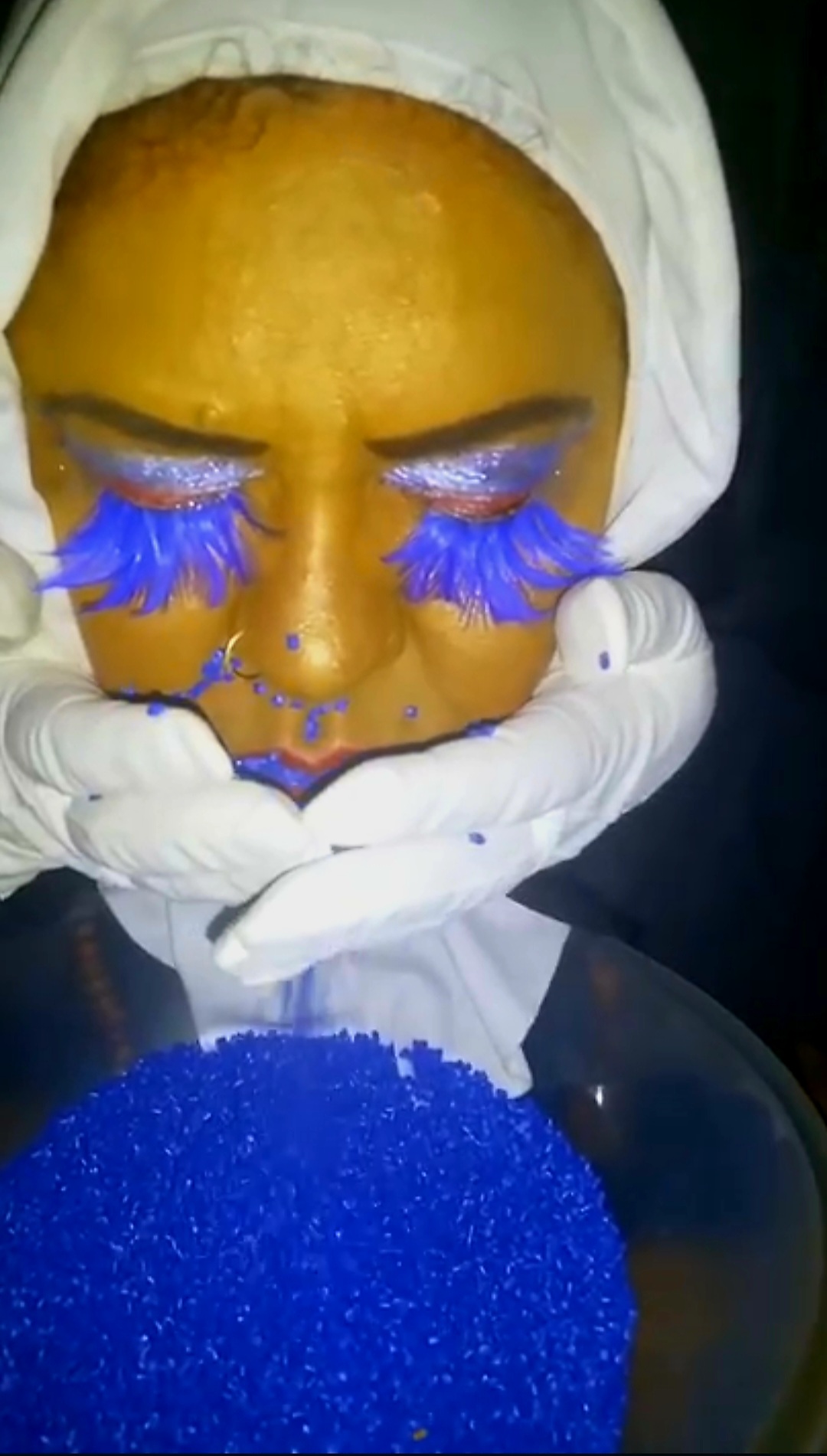
I am thrilled to have my short film, Sister GlitterNullius, The Monster Speaks: The Monstering, chosen for the SF3 Community & Diversity Award!

With so many amazing films from Australia and internationally, from stax of incredibly talented filmmakers, check out the collection on the website! Grab a friend! Grab some popcorn & immerse yourself! Click the link: https://sf3.com.au/

Many thanx SF3 for including my work and all the work you do, making such a fabulous smartphone film festival!

Sister GlitterNullius: The Monstering, 2022, Video: Richard Stalenberg, Editing, Riley Jones, Direction: Juundaal, Filmed with my Samsung Galaxy Ultra 20.

Your Friend, In & Out of Plastix!

Juundaal X

We’re not in Kandos anymore! How art transformed an out of luck town.

By Nick Galvin JULY 21, 2022, Sydney Morning Herald.

Kandos, about an hour north-west of Lithgow, is a pretty quiet town – doubly so since its main employer, the cement works and quarry, closed its doors in 2011. The second hammer blow came in 2015 when the nearby Chambon coal mine also shuttered.

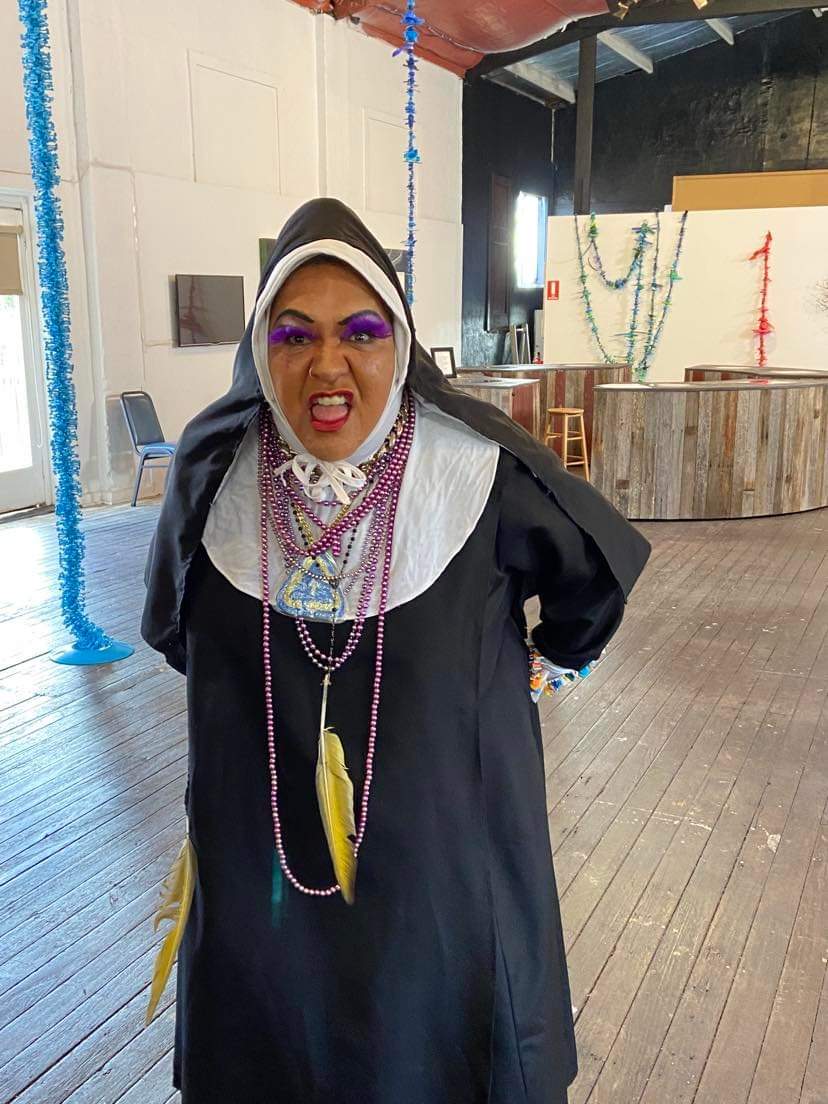
But this particular morning there is barely a parking spot to be had on the 25m wide main street. There are other signs something is afoot. I meet performance artist Juundaal Strang-Yettica, aka Sister GlitterNullius, wandering along the pavement in full nun’s habit complimented by extravagant blue eyelashes, tolling a school bell and dragging behind her a doll’s house.

She explains that she belongs to the Sisters of Perpetual Plastix and because her DNA has been infected by microplastics she is in the process of morphing into a bird. Presumably, this is not an average Saturday morning conversation in Kandos.

Meanwhile, a group of about 40 people are pacing silently around an empty paddock. It’s a walking meditation that aims to help them become “mindfully present with the vibrant sentience of the surroundings”. Again, presumably not an everyday occurrence here.

“People in Kandos are really upfront with you”: Festival Director, Alex Wisser. Photo: Gus Armstrong, 2022.

This is the fourth iteration of Cementa, a bold, four-day, biennial contemporary arts festival that bills itself as “a unique, regionally situated, socially-engaged, artist-led organisation dedicated to cultivating contemporary art in our regional context”.

Self-described “artshole” Alex Wisser is the man behind all this.

“I make, write about, think, organise, eat, breathe, love, hate, talk and sneeze art,” he says on his website. “If you ask me why, I will tell you it is because I failed as a poet but when I say that, I am just being cute.”

In person, he is a hugely engaging, stocky, heavily bearded Californian transplant, exuding an almost manic passion for Cementa and the Kandos region.

He and his family settled in Kandos in 2012, moving from Sydney’s inner-west where he had been active in the contemporary art scene.

Cementa grew from a conversation Wisser had with Ann Finnegan a co-founder of the festival. They figured the disused cement works would be a great place to activate with contemporary art. That suggestion was met with a flat “no” from Cement Australia on safety grounds.

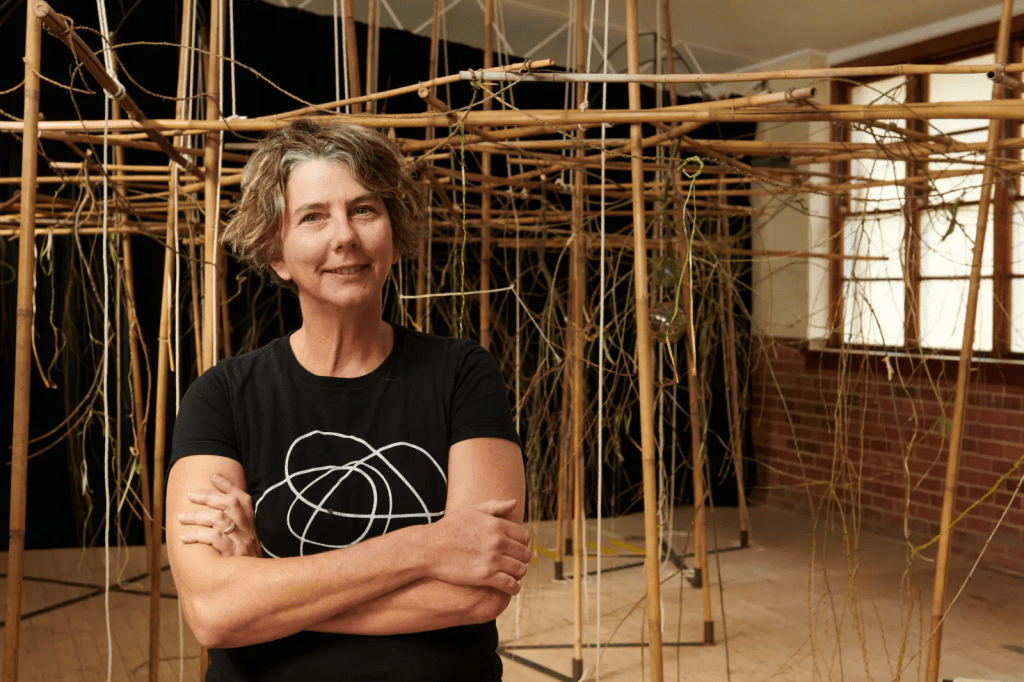
Leanne Thompson with her woven installation, Permeare at St. Dominic’s Hall in Kandos. Photo: Gus Armstrong, 2022.

“But a number of the town leaders came to the table,” says Wisser. “And they were all very encouraging. They saw the town was going to need something to revive its future – there was a lot of anxiety around the fact it was losing its defining industry. And while art was certainly not their idea of what would do that the very fact we showed up at that moment and they could see we would be bringing economic activity into the town made it an attractive option.”

Inevitably, responses from long-time Kandos residents to the prospect of a cutting-edge contemporary art festival coming to town, with all the exuberance, zaniness and way-out ideas that implies, were mixed. Reactions ranged from bemusement to plain hostility.

“One of the great examples,” says Wisser, “was when we were thinking about doing an installation in the swimming pool and we called council to ask if we could do that and I had a council worker call me back and ask, ‘So you want to put paintings in our swimming pool? Do I understand you right?’”

After the first event, Wisser and his team did a community consultation, asking for feedback and suggestions.

“One woman sort of sat in the corner of the meeting with her arms crossed for most of it,” he says. “Then, she said, ‘You’ve got to understand how scary this was for a small town like Kandos. We basically thought you were coming up here to look down your noses at us and laugh and make fun of us’.”

It brought home to Wisser how class-laden contemporary art can be.

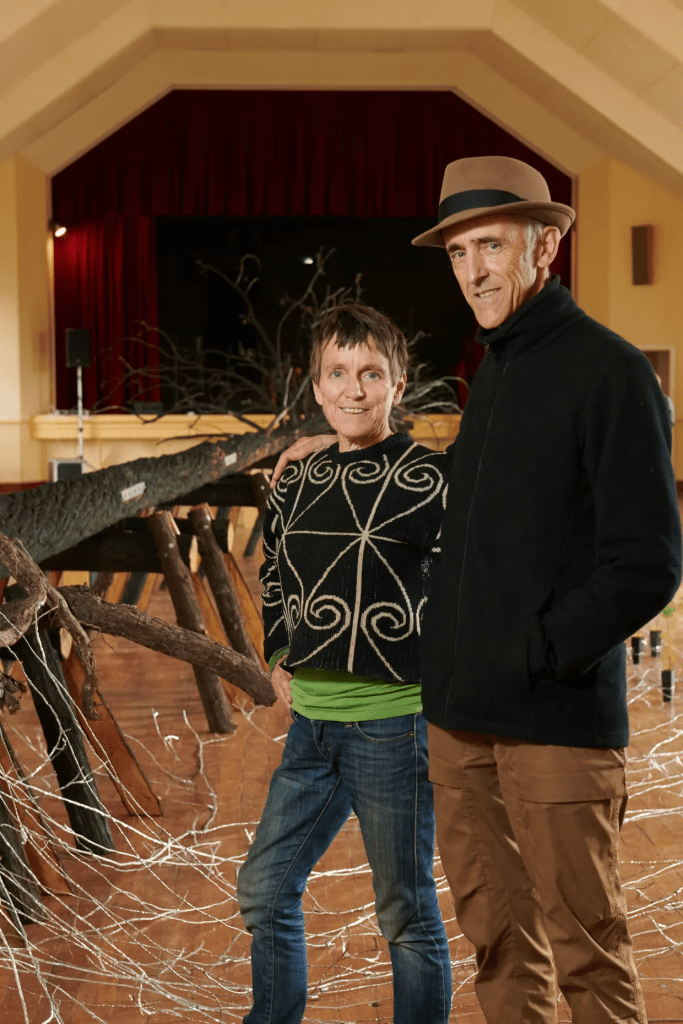
Artists Alison Clouston and Boyd with their installation Dhalawala – Forest Country at the Kandos Community Centre Hall. Photo: Gus Armstrong, 2022.

“Contemporary art is identified as a middle-class cultural expression and is alien and threatening to a lot of people who don’t participate in that culture or have access to it,” he says.

But it speaks volumes for Wisser’s passion, perseverance – and diplomatic skills – that the four-day festival has gone through four iterations now, becoming bigger and more inclusive each time.

There are installations or performances in almost every part of the town, from the disused railway station to the scout hall and the main street shops to the golf club.

The local RSL is transformed for one night to present a “Vaudevillian rollercoaster ride of community-style slam, glam punk entertainment”, while the community hall plays host for the weekend to a stunning installation featuring a massive burned tree attached to 50 of its living seedlings and accompanied by a specially composed choral work.

And Cementa is now much more than a biennial festival – it has a presence year-round with residencies and other local projects, including artist Leanne Thompson’s innovative project, Weaving Water, which aims to bring people together to restore the waterways across the Capertee Valley.

Recently, organisers also raised $180,000 to buy the old town hall building on the main street to establish a permanent art space.

Indigenous work and performance is woven through much of the festival, driven by Uncle Peter Swain, a local Dabee Wiradjuri Elder.

“I was involved with the last festival,” he says. “And, yeah, there were conversations around ‘that’s not our thing, just let them do their thing’. The locals would go and hide inside for three days and then come out again on Monday. But that’s breaking down this year, I’ve noticed.”

Swain has little time for locals looking down their nose at artists who have flocked to the region, some of them buying homes there.

“What is it to be local?” he says. “For me, if somebody lives here and they really love this place and they love it for what it is then I consider them a local whether they were born here or not. I bridge all those dynamics because of my background. When someone goes, ‘I’m fifth generation’. I can say I’m about 3,000. Don’t pull the local card on me.”

Twenty-three-year-old Bridget Baskerville grew up in the region and the impact of the industrial closures are still fresh in her mind.

“Lots of people I went to school with had to leave with the families,” she says. “It felt quite quick. And then there are less and less businesses. That seemed gradual and then you get to the point where you look around and realise we’ve lost a lot of the things I grew up with.”

Baskerville is volunteering at this year’s festival and has detected a shift in the response from her community.

“It’s a dwindling town, which can be quite sad, so suddenly to see people again reminds people of how it used to be. I think that’s really exciting. I’ve even had conversations in the past few days with people saying, ‘This isn’t really my thing but actually I’m quite interested in what’s happening’.”

Wisser doesn’t shy away from the challenges of staging a contemporary arts festival in a region struggling to come to terms with its post-industrial future. On the contrary he sees those challenges and that sometimes uneasy relationship as central to the project.

“We’re talking about a dialogue between two cultures. It’s always a process. It’s never solved. I don’t want anybody to think that I’m crowing about this as though it’s something that’s succeeded.

“We’ve had our small successes, which I’m very happy with, but those small successes along with all of our failures and breakdowns are what teaches us. It’s how we learn what the nature of our society is.”

He lives for the occasions where barriers do come down and recalls a moment at the first festival where local women and artists shared stories in a spinning circle. “I felt like these two worlds were able to fit together for a moment of shared meaning. And just the fact that it was possible for that moment really informs a lot of the hope I have, or that I derive from what we do here.”

For the artists, there is also the chance to experience the sort of refreshing candour that they don’t often get in the city arts bubble.

“People in Kandos are really upfront with you,” Wisser says. “They’ll let you know if they think something is silly, absurd or a crock of shit. It’s not a foregone conclusion that everyone’s going to congratulate you. You might get someone walk up and say, ‘Well, you’re wasting your life, aren’t you?’.”

“People in Kandos are really upfront with you,” Wisser says. “They’ll let you know if they think something is silly, absurd or a crock of shit. It’s not a foregone conclusion that everyone’s going to congratulate you. You might get someone walk up and say, ‘Well, you’re wasting your life, aren’t you?’.”

But for all his optimism, Wisser remains firmly grounded about what can be achieved.

“The lesson we learned at the first festival, is that art is not a silver bullet. Art will never save a town. It’s not an industry like a coal mine. It does bring financial benefit with it, but it really works within a mix and context. And while it’s very romantic and maybe endearing to people in the city, proposing to people in this town that you’re going to ride in on a white horse and save the day with art is ridiculous and a bit patronising.”

Nick Galvin is Arts Editor of The Sydney Morning Herald Connect via Twitter or email.

Article: Sydney Morning Herald, July 21, 2022.

Cementa22 Festival Video: 8min version is here! X

Cementa 22 Festival Promotional Video: Commissioned: Cementa Inc, Video Artist: Samuel James, Project Manager: Tammy Brennan, 2022, Music: Bendsound Free Copyright, Distribution: YouTube: https://www.youtube.com/watch?.

With her DNA infected by micro-plastix, we are reminded our inimitable Sister GlitterNullius, is homeless on many levels and for just as many reasons. Through her telescope (we know it’s a kaleidoscope) and her compass (we know is a stopwatch), she finds herself on Dabee-Wiradjuri Country, Kandos NSW. Our Nun knocks on doors & knocks on windows, seeking shelter from her storms. Until finally, the Cementa22 Festival & WAYOUT ArtSpace, provide reprieve! If only for one Festival, our Nun finds herself a Home!

Come! Come with me! Be us, ancient and new together in all directions at this long awaited once! Let our feathers be free among, and belong with the artists, the knowledge keepers, storytellers and gatherers! Arrive all colours, skins and kin! Immerse with joy and disquieting truths! As be, celebrate empathy’s compass to the monstering! Our metamorphoses, be not deficit, not deformity but, courageous, impaired and beautiful!

Funding for my Cementa22 Festival performance, Keeping Gate was generously provided by Create NSW, Small Projects Grants.

Your Friend In & Out of Plastix,

Sister GlitterNullius X

Artivism: Censorship, death, activism & art …

Bruguera, Tania, 2013, Art + activism=artivism, Speaking on her formula to artivism, Ted Talk Archive, Distributed: YouTube, https://www.youtube.com/watch?v=C38sPtBj4uo, accessed: 22.08.2022

BCM 111 Blog Post 2/3

Question: Consider what we’ve learned this week about global news reporting, and the dimension of social media in citizen journalism. Do you believe citizen journalism through social media is good, bad, or a bit of both? Why? Use academic readings to justify your conclusions. In doing so, choose a country/region of the world (that is not the US, UK, Canada, New Zealand or Australia) and discuss how it involves citizen journalism. Is it a practice that is beneficial for that region, exposing truths and stories the traditional media doesn’t cover? Does it obscure truth and spread misinformation, muddying the waters of good journalism in the region?

Just because the dominant culture or regime has not declared war, does not mean you’re not part of a citizens’ army. This idea for activism can be applied to the regions of Peru, Brazil, Bolivia, Argentina, Mexico, the list goes on… If you’re not an activist for something, perhaps you’ll fall for anything. Living under a dictatorship, injustice, corruption or colonisation, one might find themselves an activist. Often under injustice, the underdog becomes the watchdog. Censorship is often a problem but activism comes in many forms. This blog will describe censorship types, impacts for activist-journalism and propose interdisciplinary collaboration, convergence and code-switching as key strengths in producing “artivism” (Bruguera, 2013). Gonzales-Quinones & Machin-Mastromatteo (2019) articulate, the types of censorship, the worst being death.  There are five types of censorship that impact both citizen-activist and professional journalists;  self-censorship, administrative, espionage, monetary silencing and inverse censorship (Gonzales-Quinones & Machin-Mastromatteo, 2019; Johnson & Santos, 2013; Pinto, 2008; Savage & Monroy-Hernandez, 2018; Waisbord, 2009). 

Unpacking these, reveal a violent reality. Something, possibly not considered as part of Australian activist-journalism but, perhaps should. Self-censorship by activist-journalists is often the outcome of direct threats, acts of violence, sabotage, even murder. Administrative censorship is pressure by the state onto media councils and companies, forcing editorial content to favourably align with governmental or dictatorship rhetoric. Strategies of administrative censorship include manipulating or changing legislation to  control reporting. Consequently, these pressures can lead back to self censorship, for fear of reprisals (Gonzales-Quinones & Machin-Mastromatteo, 2019; Johnson & Santos, 2013; Pinto, 2008; Savage & Monroy-Hernandez, 2018; Waisbord, 2009). 

Censorship invoked by espionage often includes surveillance and hacking online activities and media platforms. This includes, profiling and targeting activist-citizen-journalists, members or groups to apply pressure, threat and or the dissemination of misinformation or propaganda. Sabotage also exists in the physical world for both professional journalists and activists. The monetization of censorship control is remuneration to extract pro-state or pro-cartel, editorial content. Thus putting pressure on outlets and or reporters to depict regimes favourably, locally and or internationally.  Drug cartels often use monetisation as inverse censorship. That is money to report violent events as a method of sending threats to their enemies (Gonzales-Quinones & Machin-Mastromatteo, 2019; Johnson & Santos, 2013; Pinto, 2008; Savage & Monroy-Hernandez, 2018; Waisbord, 2009). 

Article Image: Asmann, Parker, 2018, Latin America is the deadliest region for environmental activists: protest over the death of environmental activist, Berta Caceres, Honduras, 2016, , Open Democracy, blog, Image: accessed: 21.08.2022.

Citizen-activist journalism, however flawed or unprofessional it may seem at times, is necessary, fact checking is also always necessary. One example of citizen net-activism, Blog del Narco appeared in 2010. This anonymous blog reported on cartel activity and violence not represented in mainstream media. Net-activism, while being able to reach a larger audience than traditional types of media, leaves groups and its members vulnerable to being surveilled, individually identified, intimidated or worse. Suppression of information might be seen as one of the least harmful ways of silencing people when persecution and or even death could be an outcome. From these examples of censorship, activist or watchdog journalism is a deadly but necessary business in the South Americas (Gonzales-Quinones & Machin-Mastromatteo, 2019; Johnson & Santos, 2013; Pinto, 2008; Savage & Monroy-Hernandez, 2018; Waisbord, 2009). 

As I alluded in the first paragraph, activism comes in many forms and one key disruption to the censorship of activism is socially engaged, interdisciplinary collaboration. Intersectional activism is often seen in art. Moreover, it also often intersects with other significant issues caused by injustice, such as First Nations sovereignty and the environment. The collaborative video work, Con las guardianas del agua (With the guardians of water); (Morales et al, 2019), demonstrates the power of combining activist-journalism, contemporary art, technology and social media. Interdisciplinary socially engaged collaboration compounds the power to raise awareness, interrogate and interrupt injustice. This kind of collaborative convergence, not only strengthens the activism but also the complexities of code-switching dynamic languages, by the underdog and allies alike (Gonzales-Quinones & Machin-Mastromatteo, 2019; Johnson & Santos, 2013; Morales, et al, 2019; Pinto, 2008; Savage & Monroy-Hernandez, 2018; Waisbord, 2009). 

Morales, Daniela; Hernandez, Paz Maria Sintia Plaza; Cifuentes, Socorro Cancino; Denham, Ben, 2019, Con las guardianas del agua (With the guardians of water), Remedios Remix, a collection of First Nations voices for Country, With the Guardians of Water / Con las Guardianas del agua – English Subtitles https://remediosremix.art/2019/10/29/with-the-guardians-of-water/, accessed: 14-19.08.2022. 

Reference List:

Bruguera, Tania, 2013, Art + activism = artivism, Ted Talk Archive, Distributed YouTube, accessed: 22.08.2022.

Gonzalez-Quinones, Fidel & Machin-Mastromatteo, Juan D, 2019, ‘On Media Censorship: Freedom of expression & the risks of journalism in Mexico’, Information Development Index, Vol.35(4), p.666-670, Sage Publications, accessed: 20.08.2022.

Johnson, Shelly & Santos, Alessandra, 2013, ‘REDressing Invisibility & Marking Violence Against Indigenous Women in the Americas Through Art, Activism & Advocacy’, First People’s Child & Family Review, Vol.7, No.2, p.97-111, erudit.org, https://www.erudit.org/en/journals/fpcfr/1900-v1-n1-fpcfr05243/1068844ar.pdf, accessed: 20.08.2022.

Morales, Daniela; Hernandez, Paz Maria Sintia Plaza; Cifuentes, Socorro Cancino; Denham, Ben, 2019, Con las guardianas del agua (With the guardians of water), blog post, Remedios Remix, collective workshop in Water Conflicts in Abya Yala: Sociology of the Image, La Paz, Bolivia, https://remediosremix.art/rearguard-remix-remix-de-retaguardia/, https://remediosremix.art/2019/12/19/tenemos-redes-que-seguir-tejiendo/, accessed: 14-19.08.2022.

Pinto, Juliet, 2008, Muzzling the watchdog: The case of disappearing watchdog journalism from Argentine mainstream news, Journalism, Vol.9(6), p.750-774, DOI: 10.1177/1464884908096244, accessed:18.08.2022.

Savage, Saiph & Monroy-Hernández, Andre, 2018, ‘The Courage For” Facebook Pages: Advocacy Citizen Journalism in the Wild’, Citeseer, psu.edu, accessed: 20.08.2022.

Waisbord, Silvio, 2009, Advocacy Journalism in a Global Context in The Handbook of Journalism Studies, Ch.26, p.391-405, Wahl-Jorgensen, Karin & Hanitzch, Thomas (eds.), International Communication Association Handbook Series, Routledge, New York & London.

Bibliography:

Anonymous, 2010, Blog del Narco, https://www.blogdelnarcomexico.com/, accessed: 28.08.2022.

Gonzalez, Tanya, 2009, Art, Activism & Community; An introduction to Latina/o Literature, in Ethnic Literary Tradition in American Children’s Literature, Stewart MP & Atkinson Y (eds.), Palgrave Macmillan, New York, DOI: 10.105719780230101524_15, accessed: 15.08.2022.

Ksiazek & Webster, 2008, Cultural Proximity I Audience Behaviour: The Role of Language in Patterns of Polarisation & Multi-Cultural Fluency, Journal of Broadcasting & Electronic Media, Vol.52:3. P.485-503, accessed: 08.2022.

Lyon, David, 2002, Everyday Surveillance: Personal Data & Social Classifications; Information, Communication & Society, Iss.5, No.2, p.242-257, Taylor & Francis, accessed: 04.04.2022.

O’Shaughnessy, M, 2012, Globalisation in Media & Society, p.458-471, Oxford University Press, England, accessed: 08.2022.

Todd, Zoe, 2015, Indigenising the Anthropocene, Art in the Anthropocene: encounters among aesthetics, politics, environments & epistemologies, Open Humanities Press.

Wolfe, Patrick, 2006, Settler colonialism & the elimination of the native, Journal of Genocide Research, Vol.8:4, p.387-409, DOI:10.1080/146235220601056240, accessed: 12.08.2022.

Images & Videos:

Asmann, Parker, 2018, Latin America is the deadliest region for environmental activists, Open Democracy, blog, https://www.opendemocracy.net/en/democraciaabierta/latin-america-is-deadliest-region-for-environmental-activists, Image: accessed: 21.08.2022.

Bruguera, Tania, 2013, Art + activism = artivism, Ted Talk Archive, Distributed YouTube, accessed: 22.08.2022.

Morales, Daniela; Hernandez, Paz Maria Sintia Plaza; Cifuentes, Socorro Cancino; Denham, Ben, 2019, Con las guardianas del agua (With the guardians of water), Remedios Remix, With the Guardians of Water / Con las Guardianas del agua – English Subtitles https://remediosremix.art/2019/10/29/with-the-guardians-of-water/, Distributed: YouTube, accessed: 14-19.08.2022. 

End

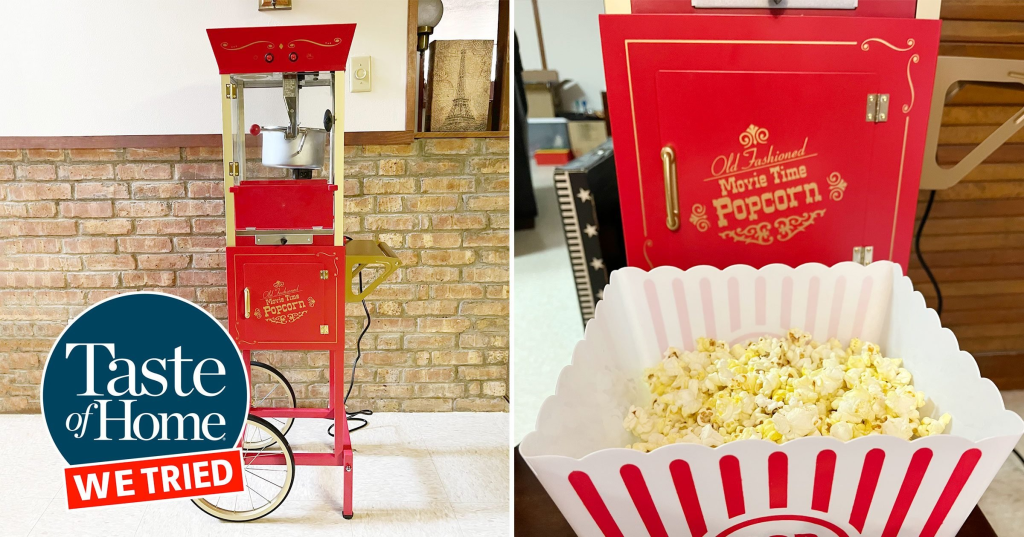
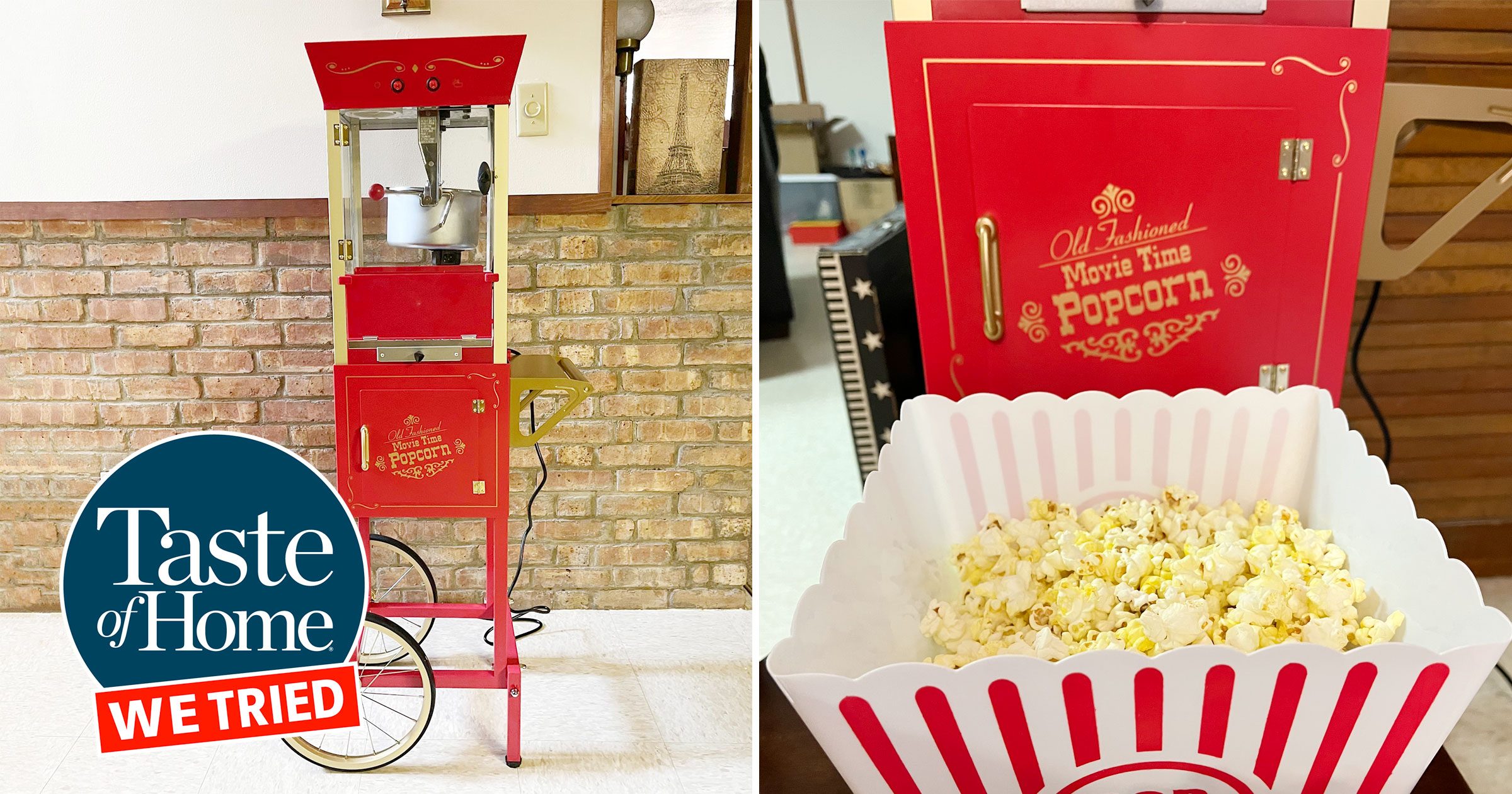
Popcorn Anyone?

 Image: Taste of Home: https://www.tasteofhome.com/wp-content/uploads/2022/06/TOH-we-tried-social-nostalgia-popcorn-machine-Emily-Parulski.jpg

BCM 111 Assignment 1: Blog 1/3: Question: What popular culture do you consume? Explain its popularity using one of the key theories. Use two academic sources from the Subject Readings, your own or a combination. Post to Twitter with #BCM111.

Notice: Aboriginal & Torres Strait Islanders, this blog contains images and voices of people who are deceased.

Popcorn Anyone?

I have an issue with popcorn… I do. I deploy the word popcorn as a race theory metaphor for my critical mistrust of capitalist and consumerist mass media, commodification of indigeneity and exploitation of the environment. Through this lens, most popular culture rhetoric, popcorn-culture, seems either destructively entitled, ignorant and unaccountable to either. This leaves us in a chronic homogenised Anthropocene, of intellectual and cultural malnutrition (Carlson & Frazer, 2018; Friedman, 2010; hooks, 1992; McFarlane, 2003; Moreton-Robinson, 2009; O’Shaughnessy, 2012;  Todd, 2015; Wolfe, 2006).

Like anything created by humans, popcorn-culture and mass media have both positive and negative aspects concurrently. O’Shaughnessy, (2012) outlines utopian and dystopian elements of living in a networked, global community such as, a sense of connectedness for many, versus appropriation and exploitation of culture for others (Allas, 2015; Carlson & Frazer, 2018; Friedman, 2010; McFarlane, 2003; Moreton-Robinson, 2009; Todd, 2015). I’m not afraid of being wrong about popcorn. What I’m afraid of is, commodification as another way dominant culture perpetuates ethnographic invisibility of indigeneity via its popcorn machines rather than, acknowledging our contributions to the networked, global village and with more than just popular culture (Allas, 2015; Carlson & Frazer, 2018; Friedman, 2010; McFarlane, 2003; Moreton-Robinson, 2009; O’Shaughnessy, 2012; Todd, 2015; Wolfe, 2006).

Excluding nations like Dharawal and other Indigenous nations (Australia), Māori (New Zealand) and the Native Indian nations (United States) from discussions of mainstream, popular culture and globalisation, contributes to ongoing denial that diverse Indigenous nations live in dual cultures but same geographies, it’s a digitally networked type of ethnography. If the argument is that English is the predominant language of those countries, that would be the first clue that, culturally and socio-politically, there might be cause for concern. Our contribution to popular culture per capita, is unmatched (Allas, 2015; Carlson & Frazer, 2018; Friedman, 2010; McFarlane, 2003; Moreton-Robinson, 2009; O’Shaughnessy, 2012; Todd, 2015; Wolfe, 2006).

Example: indigenous popular culture,  cultural & linguistic duality and allyship, Yunupingu, Gurrumul & Kelly Paul, 2016, Amazing Grace, performed live on Q & A, Mental As, Australian Broadcasting Commission, ABC, Distributed: YouTube, accessed: 15.08.2022.

I would love to deep dive into a supersized bucket of popcorn and wallow in the buttery privilege of simply, answering the assignment question, about my me-centred popcorn bingeing. However, when the topic fails to include the world’s indigenous voices within these contexts, it forces my indigenous intellectual hand to shake the popcorn and the bucket! My assignment answer then, is handed over to blaktivism. Instead of choking on over-puffed, non-Indigenous flavoured popcorn in the dark with strangers and simply answering the assignment question, I must blak track. Blak tracking, as I call it, requires I do at least three times the work to make indigeneity visible as a key contemporary, cultural contributor, not being excluded from these scripts (Allas, 2015; Carlson & Frazer, 2018; Friedman, 2010; hooks, 1992; Ksiazek & Webster, 2008; McFarlane, 2003; Moreton-Robinson, 2009; Wolfe, 2010).

Example: Contemporary songlines, through media convergence and intergenerational collaboration, Archie Roach Covers Bob Marley, ‘Redemption Song/OneLove/Get Up Stand/Up’ for Like a Version, Triple J Radio, (00.00-00.60), (clip), Distributor: YouTube:https://www.youtube.com/watch?v=tSj-LFju6Oc, accessed:14.08.2022.

Not only do I feel pressure to learn and appropriately regurgitate non-Indigenous content better than most students, but I must also set about locating and absorbing research that edits and corrects ethnographic narratives and non-narratives. I need to gather evidence for and of, my absolute frustration about digression from the set assignment. Then, as my assignment stands, I am decolonising a vernacular that consistently relegates indigeneity to the fringes of society and the global conversation. We are a global culture (Allas, 2015; Carlson & Frazer, 2018; Friedman, 2010; hooks, 1992; Ksiazek & Webster, 2008; McFarlane, 2003; Moreton-Robinson, 2009; Wolfe, 2010). 

Example: Decolonising education,  Dr. Jodi Edwards (ed.), Dharawal: Words, Phrases & Activities, 2022, Image: <https://pbs.twimg.com/media/FXC0e8naMAEBrZh?format=jpg&name=large&gt;, accessed:13.08.2022.

Perhaps the point has missed me and there’s more to learn around future’s corner or… I’m just allergic to popcorn. I’m going to conclude this blog from a decolonised, culturally revitalised position of strength, with an example of one Indigenous nation, the Dharawal people, thriving in dual cultures, utilising the western popular culture format of a colouring-in and activity book, to share ancient knowledge with Indigenous and non, for generations now and to come – and that’s how I think inclusivity could work in the networked, globalised village, glocally (Allas, 2015; Carlson & Frazer, 2018; Friedman, 2010; McFarlane, 2003; Moreton-Robinson, 2009; O’Shaughnessy, 2012; Todd, 2015; Wolfe, 2006).

Thanx for popping by…

Juundaal Strang-Yettica BCM 110

REFERENCE LIST:

Allas, Ruben D, 2015, Globalisation in Art & Culture, 2015, article for Artlink Magazine, June 2015, p.1-13.

Carlson, Bronwyn; Frazer, Ryan, 2018, ‘Yarning circles & media activism’, Media International, Vol.169, Iss.1, p.43-53, <https://journals-sagepub-com.ezproxy.uow.edu.au/doi/10.1177/1329878X18803762?icid=int.sj-full-text.similar-articles.2&gt;, accessed 13.08.2022.

Friedman, Jonathon, 2010, ‘Indigenous Struggles & The Discreet Charm of the Bourgeoisie’, The Australian Journal of Anthropology, Vol.10:1, p.1-14, Social Anthropology, University of Lund, accessed: 13.08.2022.

hooks, bell, 1992 Black Looks: race & representation, 1992 & 2015, South End Press, Boston, US.

Ksiazek, Thomas & Webster, James, 2008, ‘Cultural Proximity I Audience Behaviour: The Role of Language in Patterns of Polarisation & Multi-Cultural Fluency’, Journal of Broadcasting & Electronic Media, Vol.52:3. P.485-503, accessed: 08.2022.

McFarlane, Brian, 2003, ‘Back Tracking’, Meanjin, Vol.62, Iss.1, p.59-58, Melbourne University Publishing, Australia, ISSN:0025-6293.

Moreton-Robinson, Aileen, 2009, ‘Imagining the good Indigenous citizen: Race War & the pathology of Patriarchal White Sovereignty’, UTC: Cultural Studies Review, Creative Commons Licence.

O’Shaughnessy, Michael, 2012, Globalisation in Media & Society, p.458-471, Oxford University Press, England, accessed: 08.2022..

Todd, Zoe, 2015, Indigenising the Anthropocene, Art in the Anthropocene: encounters among aesthetics, politics, environments & epistemologies, Open Humanities Press.

Wolfe, Patrick, 2006, ‘Settler colonialism & the elimination of the native’, Journal of Genocide Research, Vol.8:4, p.387-409, DOI:10.1080/146235220601056240, accessed: 12.08.2022.

BIBLIOGRAPHY:

Australian Arts Review blog post, 2019, ‘Blak & Bright: First Nations Literary Festival’, Australian Arts Review, <https://artsreview.com.au/blak-bright-first-nations-literary-festival/&gt;, accessed: 13.08.2022.

Bauer, Elise, 2022, ‘Perfect Popcorn: How to make a perfect batch of popcorn with no burnt kernels! Easy stove-top recipe’, Simply Recipes blog post, 03.01.2022, <https://www.simplyrecipes.com/recipes/perfect_popcorn/&gt;, accessed: 07.08.2022.

Edwards, Dustin W, 2020, ‘Digital Rhetoric on a Damaged Planet: Storying Digital Damage as Inventive Response to the Anthropocene’, Rhetoric Review, Vol.30:1, p.59-72, <https://www-tandfonline-com.ezproxy.uow.edu.au/doi/pdf/10.1080/07350198.2019.1690372&gt;, accessed: 07.08.2022.

Gergan, Mabel; Smith, Sara; Vasudevan, Pavithra, 2020, ‘Earth beyond repair: Race & apocalypse in collective imagination’, Environment & Planning D: Society & Space, Vol.38:1, p.91-110,<https://journals-sagepub-com.ezproxy.uow.edu.au/doi/full/10.1177/0263775818756079&gt;, accessed: 05.08.2022.

Langton, Marcia, 2008, ‘Trapped in the Aboriginality reality show,’ Griffith Review, Iss:19, p.143-159, <https://www.griffithreview.com/articles/trapped-in-the-aboriginal-reality-show/ >, accessed: 15.08.2022.

Latour, Bruno; Stengers, Isabelle; Tsing Anna; Bubandt, Nils, 2018, ‘Anthropologists are Talking About Capitalism, Ecology & Apocalypse’, Ethnos: Journal of Anthropology, Vol.83, Iss.3, accessed: 23.07.2022.

McCausland, Ruth, 2014, ‘Special treatment: the representation of Aboriginal People & Torres Strait Islander people in the media’, Journal of Indigenous Policy, <http://unsworks.unsw.edu.au/fapi/datastream/unsworks:77034/binca5017ae-1906-4de8-9ab9-ec8e320cca84?view=true&xy=01&gt;, accessed: 05.08.2022.

Moreton-Robinson, Aileen (ed.), 2004, Whitening Race: Essays in social and cultural criticism, Aboriginal Studies Press, Canberra, Australia.

Shifroni, Tamar 2012, Integrating Indigenous Culture & History into Popular Australian Media: An analysis of the 2012, Australian film, The Sapphires, WordPress blog, posted: 24.10.2018, <https://tamarshifroni.wordpress.com/2018/10/24/integrating-indigenous-culture-and-history-into-popular-australian-media-an-analysis-of-the-2012-australian-film-the-sapphires&gt;, accessed: 07.08.2022.

Singh, Michael, 1998, ‘Globalism, cultural diversity & tertiary education’, The Australian universities review, Vol.41:2, p.12-19, accessed: 13.08.2022, <https://search-informit-org.ezproxy.uow.edu.au/doi/epdf/10.3316/aeipt.93732&gt;, accessed: 10.08.2022.  

Tiddas, 1993, Inanay, album, Sing About Life, Mercury Records Pty. Ltd, Distribution: Universal Music Group & YouTube, accessed: 14.08.2022

Tsing, Anna Lowenhaupt, Bubandt, Nils, Gan, Elaine, Swanson, Heather Anne, 2017, Arts of Living on a Damaged Planet: Ghosts & Monsters of the Anthropocene, University of Minnesota Press, USA.

Yunkaporta, Tyson, 2019, sand talk, Text Publishing Company, Melbourne, VIC.

IMAGES & VIDEOS:

Parulski, Emily, 2022, Taste of Home, https://www.tasteofhome.com/wp-content/uploads/2022/06/TOH-we-tried-social-nostalgia-popcorn-machine-Emily-Parulski.jpg, popcorn machine review, accessed: 08.08.2022.

Yunupingu, Gurrumul & Kelly, Paul, 2016, Amazing Grace, performed live on Q & A, Mental As, Australian Broadcasting Commission, ABC, Distributed: YouTube, accessed: 15.08.2022.

Archie Roach Covers Bob Marley, ‘Redemption Song/OneLove/Get Up Stand/Up’ for Like a Version, Triple J Radio, (00.00-06.10), (full version), <https://www.youtube.com/watch?v=tSj-LFju6Oc&gt;, Archie Roach covers Bob Marley ‘Redemption Song / One Love / Get Up, Stand Up’ for Like A Version, Distributor: YouTube, accessed: 14.08.2022.

Edwards, Jodi Dr.(ed.), 2022, Dharawal: words, Phrases & Activities, Dharawal Publications, Sydney Australia.

ADSR Zine! X

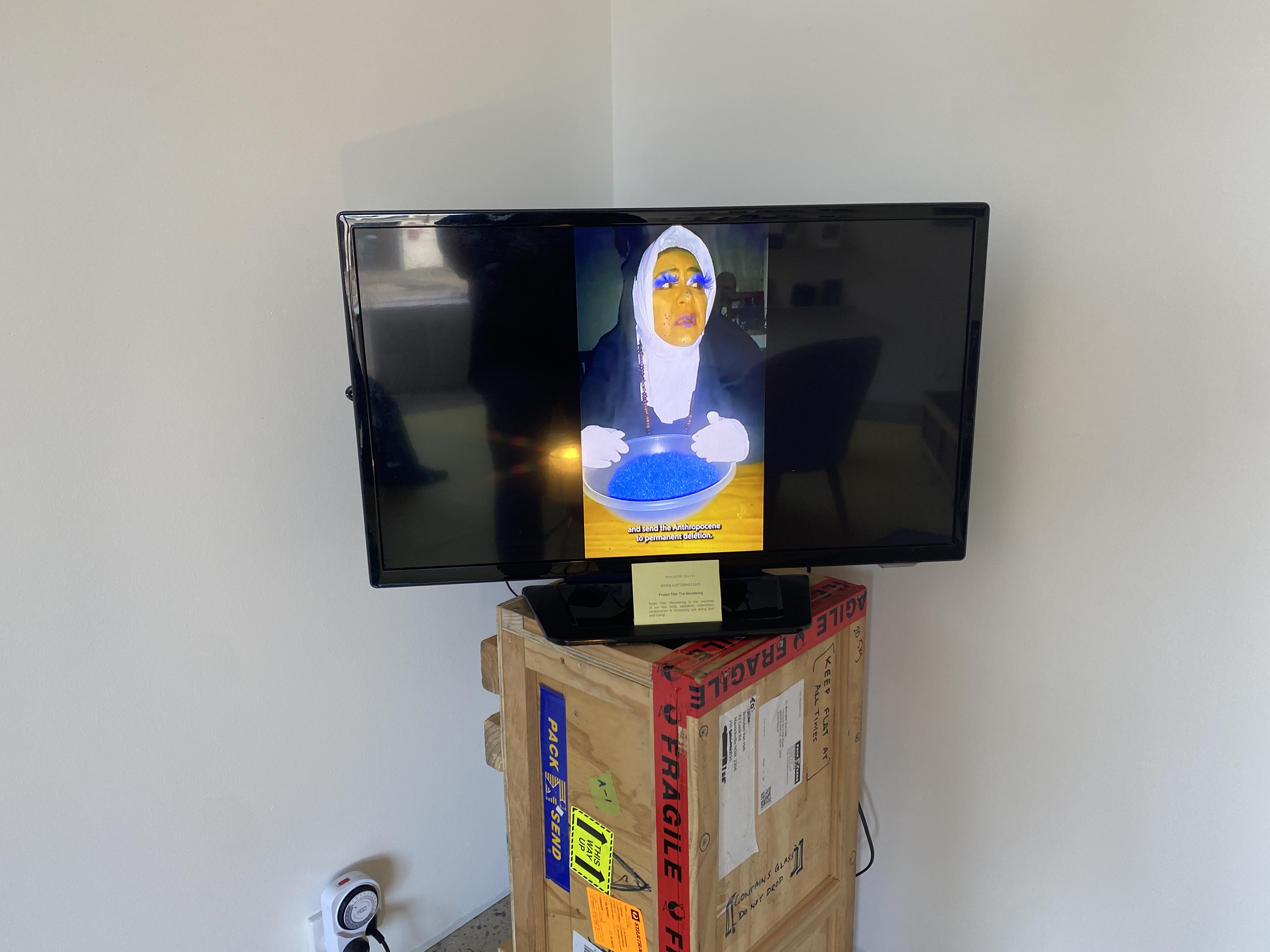
Video: Richard Stalenberg Edit: Riley Jones, 2022.

So thrilled to have been included in ADSR Zine’s archive opening & latest edition! Thankyou!

Sister and speaks of the Monstering. All the actions, our actions that have brought us into the Anthropocene. This short video highlights what Sister GlitterNullius calls, the Digitalocene.

Your Friend, In & Out of Plastix! X

… HOW MUCH CAN ONE MOTHER EARTH TAKE BEFORE THE WOUND IS TOO DEEP?… X

Going Home, 2020, Collaborating Editor: Riley Jones.

As the plastix hits, I weep for us all my children. Please come sit by me… Hold my hand a while…? My heart is wounded and laden. I pray I am not losing faith but I feel an indescribable pull…

As the plastic hits, I feel different… Where can one nun start or finish…? Let’s play a game! How many plastic items can you see in front of you? Behind you? Beside you? Above or under you? On you… In you…?

Your Friend, In & Out of Plastix,

Sister GlitterNullius. X

Plastic-free Kandos Photo Album!

An extension of Plastic-free Biennale…

You know those times when you look around you & realise some people just want good things for you? I have so much gratitude for the people of Kandos, Cementa,  WayOut ArtSpace, Alex Wisser, Michael & Jack who helped us put the exhibition together, working with Rox De Luca & of course, my Mentors Lucas Ihlein & Kim Williams. Yes, this is supposed to be a post about the what we did & what we achieved- which was huge. But for the moment, I’m just ok to tell you about the people and opportunity I’m grateful for.

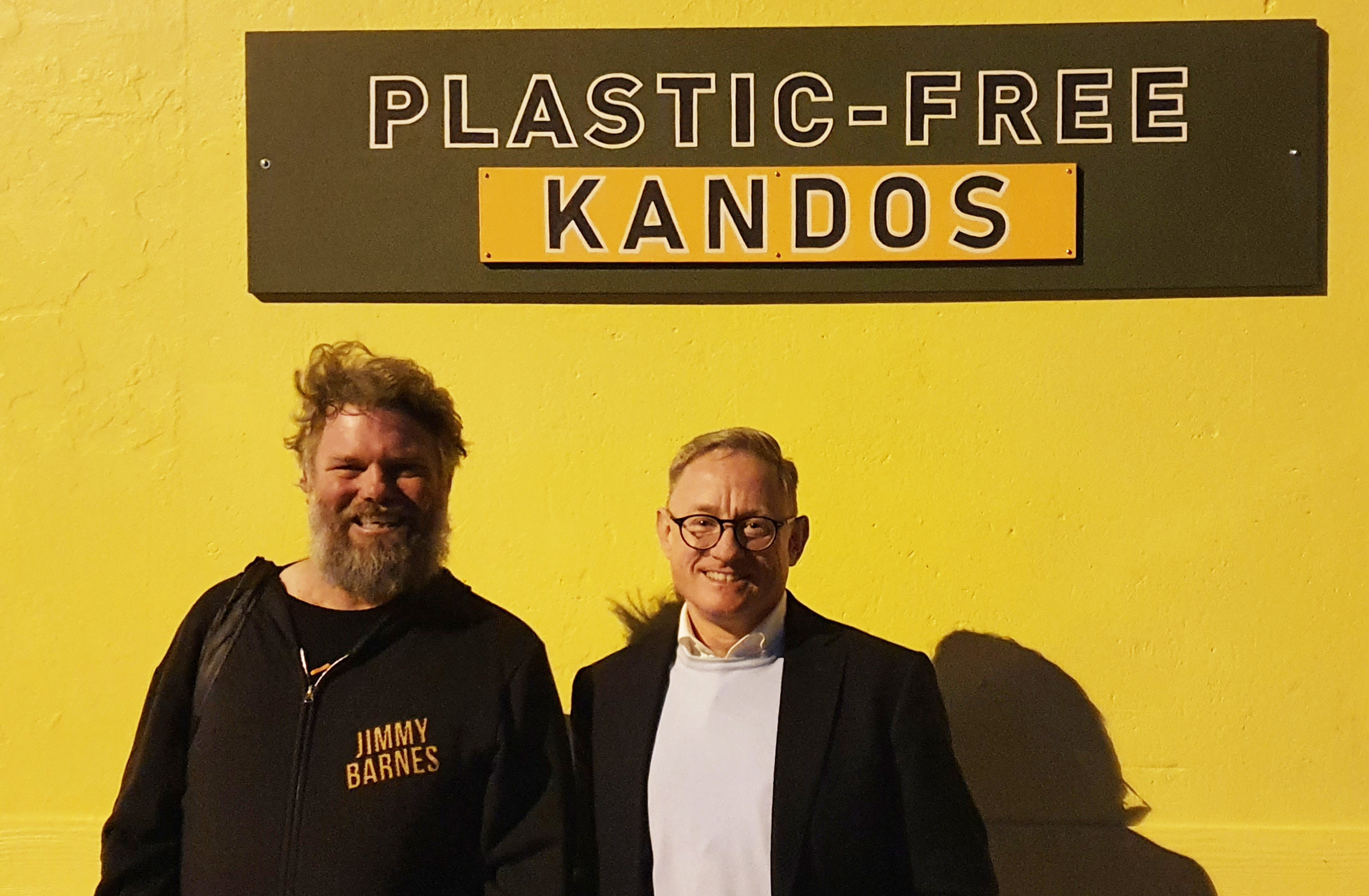
Image: Alex Wisser, Cementa Director with the Minister for the Arts, Aboriginal Affairs, Regional Youth, NSW, outside WAYOUT ArtSpace, Kandos, NSW.

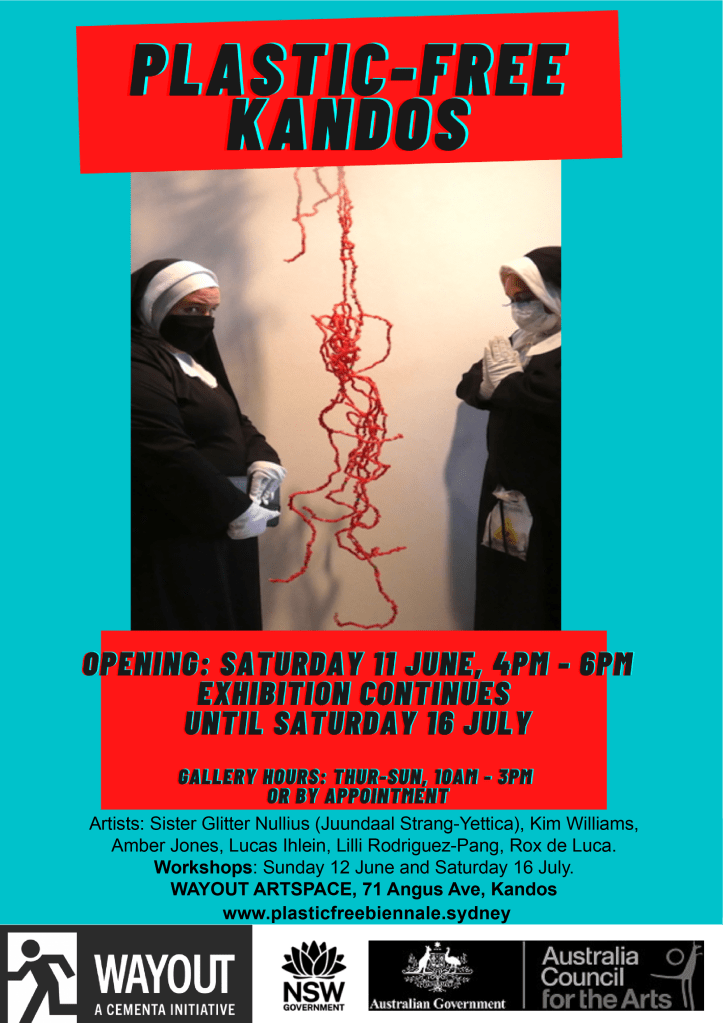
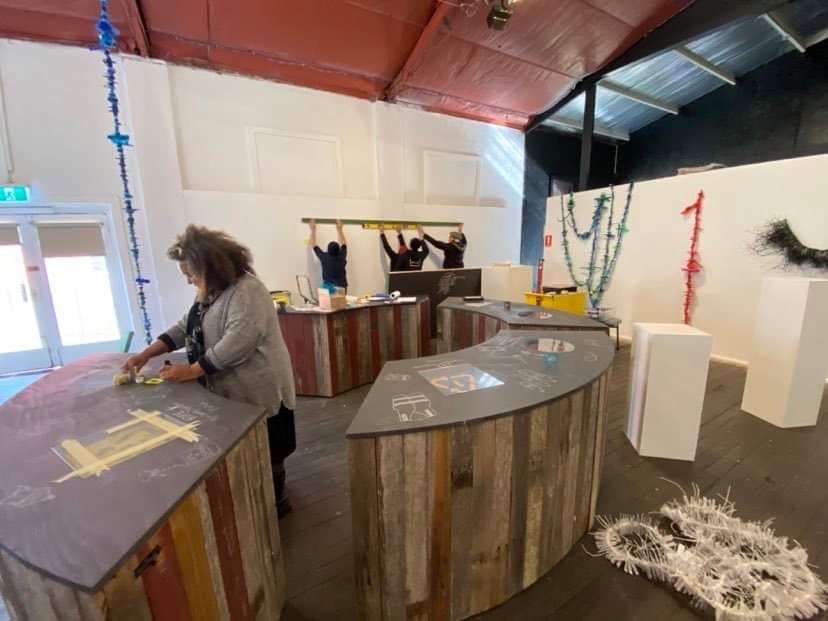
Plastic-free Kandos: a group project, stemming from Kim Williams & Lucas Ihlein’s Plastic-free Biennale (2020) in NIRIN, the Sydney Biennale. It brought a group project from the city to the regional town of Kandos in NSW. It was an amazing opportunity to share with the local community, an exhibition of installations, social engagement workshops, performance and artist talks. This project was made with the support and assistance from many! Funding support was gratefully received from Create NSW, Small Projects Grants and Creative Leaderships.

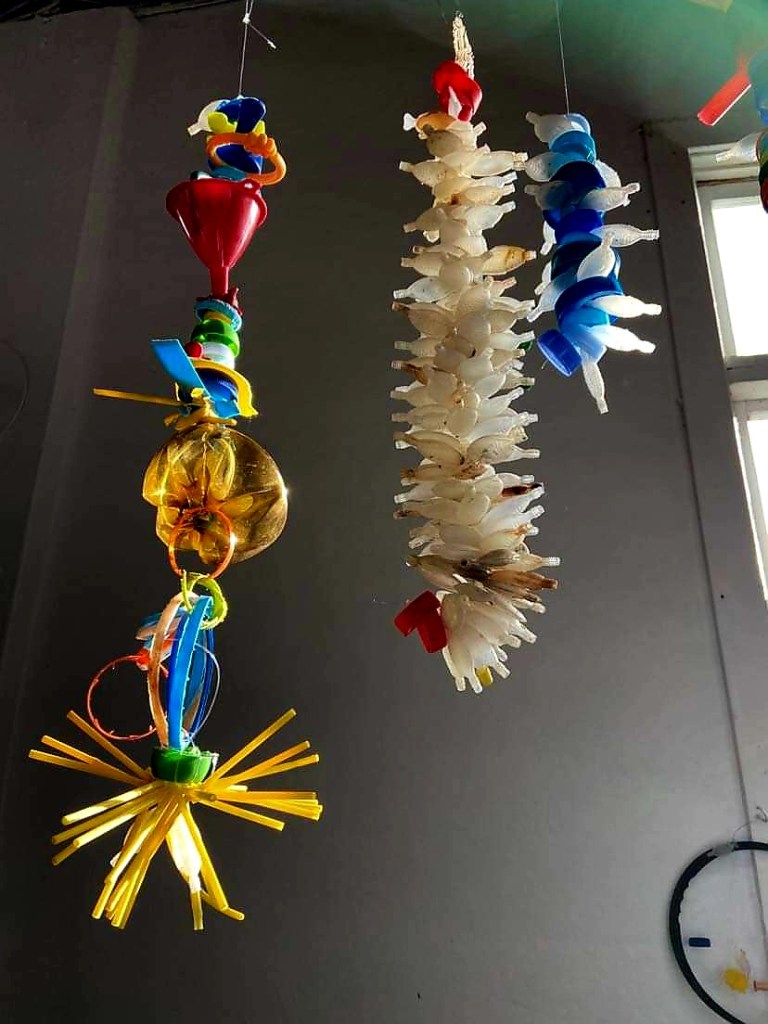
Community artworks made with Rox De Luca, WAYOUT ArtSpace, Kandos NSW.

Bump-in for Plastic-free Kandos!

Plastic-free Kandos at WAYOUT ArtSpace, Kandos, Dabee Land, Wiradjuri Country, NSW. Image: Rox De Luca, 2022.

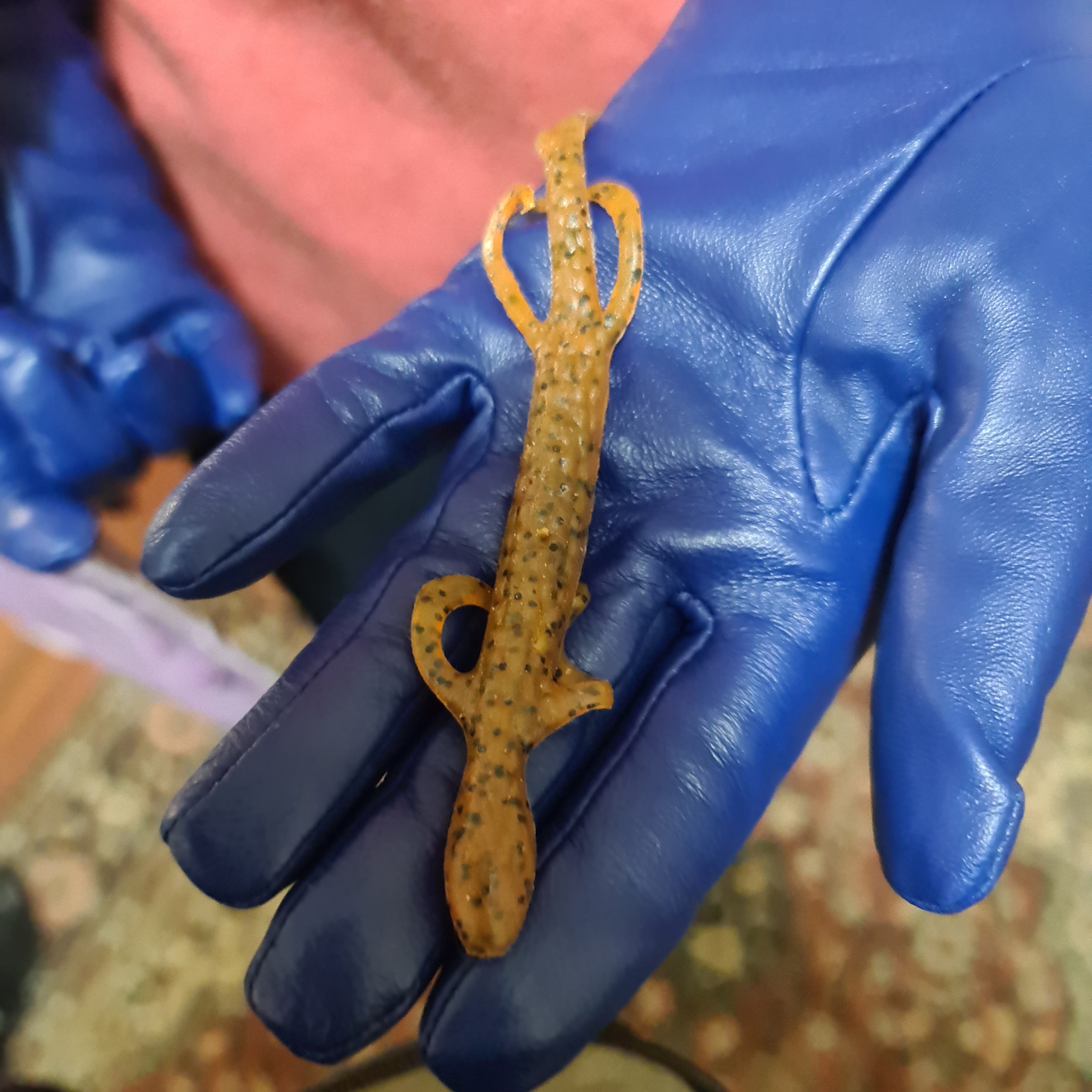
Found object!

Thanx for stopping by!

#regionalart #dabeewiradjuri #kandosnsw #plasticfreekandos #wayoutartspace #cementa #creatensw #groupproject #socialengagement #multidisciplinaryart #intersectionalenvironmentalism #contemporaryart